German Awards - Military Service Award Buckle 3. Class Code JFE
In the Duchy of Saxe-Altenburg, military service awards were first established on January 1, 1836 by Duke Joseph Friedrich Ernst. A cross was established for officers after 25 years of service and buckles for sergeant major, non-commissioned officers and soldiers, as well as for gendarmes of the 3rd class. The 1st class for sergeant major below was a silver gilt buckle and was awarded for 12 years of service. The 2nd grade with the same design was a silver buckle and became 9th. Years of service. Shown here 3. The class consisted of black cast iron with a silver frame. Only active years of service were considered. Vacation was paid only half. Wartime was considered double. Service awards until 1867 changed twice more. When Duke Georg Karl Friedrich took office in 1848, the cipher changed to - GKF -. Years of service were retained. The last modification of the buckles occurred in 1853 with the coming to power of Duke Ernst I. The cipher was changed to - E. The years of service were adjusted after the military convention with Prussia in 1867 in 1869. 1st class was now awarded after 21 years of service, 2nd class after 15 years, and 3rd class after 9 years. Due to the small size of the contingent and the short lease term, all service awards are very rare. Source: J. Nimmergut, Deutsche Orden und Ehrenzeichen bis 1945, vol. III, 1999.
Rectangular buckle made of blackened cast iron. They are bordered by a silver frame. The buckle is placed with a jumper on a metal strip covered with tape, with a pin with a mating hook boarded up at the back.
Front side:
- The black inside of the buckle is finely indented.
In the - center, the code increases - JFE - at a fracture. Above it is a 5-beam crown.
Downside:
- The tape is stretched over the metal strip and through the rear jumper of the buckle.
In - the upper part there is a horizontal pin with mating hooks.
Tape:
- 36 mm dark green, green edges, black side stripes 3 mm.
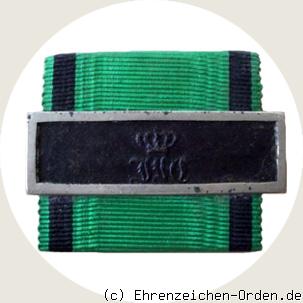 Front: Military Service Award Buckle 3. Class Code JFE
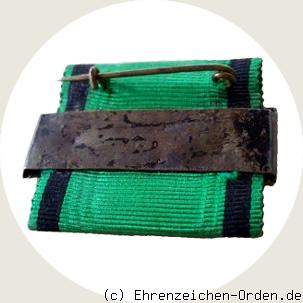 Reverse: Military Service Award Buckle 3. Class Code JFE
Established:
January 1, 1836 by Duke Joseph Friedrich Ernst
Data:
- Material: iron, silver, tape
- Size: 40mm x 13mm buckle
- Weight: about 6g
estimated collector price:
220 – 250 €

 Awards of World War II