German Awards - 1st Class War Honours Cross
After the renewal of the cross for distinction in the war on August 11, 1914, Grand Duke Adolf Frederick VI established it. 1st class cross for distinctions in war. Previously existing in one class, the award on the tape has now become the 2nd. The class is denoted. The cross was awarded for repeated outstanding courage in front of the enemy. Officers, non-commissioned officers or soldiers were eligible. Due to unworthy behavior, the cross was withdrawn. 3 variants of the cross are known. The 1st option has a 2-line inscription in the central shield - FOR - COURAGE - and has the number of the year -1914 - on the lower cruciform shoulder in the recess. The 2nd option has a 3-line font in the central shield - TAPFER - AND - TREU -. These crosses don't have a year. The 3rd option has a crowned name in the central shield - A F - the number of the year - 1914 is embossed on the lower cross shoulder. The maker of the crosses was Godet & Sohn. A total of 288 crosses were made, of which 165 were silver. There are also known copies of the Meibauer company. In the 1st World War from 1915 to 1918, only a few crosses were awarded with the inscription - FOR - COURAGE - in silver. Since 1917, silver crosses began to be awarded. Источник: Peter Ohm-Hieronymussen, Die Mecklenburg-Strelitzer Orden und Ehrenzeichen, 2000.
Silver Cross. The transverse arms are smoothly polished and at a short distance from the edge have a raised transversely shaded edging. On the front side is a large round central shield. The back side is smooth with a vertical pin. (several silver-plated pieces with side hooks) Maybauer pieces with a screw disk are also known.
Front side:
- The round central shield is surrounded by a thick laurel wreath.
- Below it is cruciform. The closed field is numbered.
In the - center is an elevated 2-line font: - FOR -/- COURAGE -.
- On the lower cross sleeve in the recess is an elevated number of the year - 1914 -.
Downside:
- Smooth with a vertical pin.
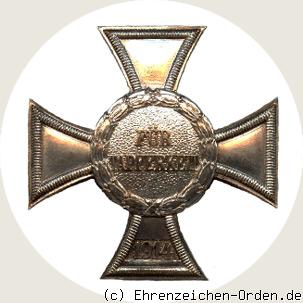 Obverse: Cross for Distinction in 1st Class War
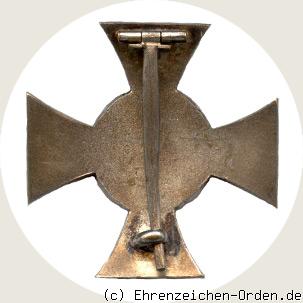 Reverse: Cross for Distinction in 1st Class War
Established:
January 1, 1915 by the Grand Duke Adolf Frederick VI.
Data:
- Material: silver or silver
- Size: 40 to 41mm
- Weight: Silver 18g, silver-plated 12 - 17g
estimated collector price:
1300 - 1450 € silver
700 - 800 € silver plated

 Awards of World War II