German Awards - King Ernst August Gold Medal (Big Head) 1846
On June 5, 1841, King Ernst August established new merit medals with his portrait. They were awarded silver and gold in 2 classes. The tradition of merit medals dates back to 1815. Prince Regent George first donated them in the counties of his father, King George III. of Great Britain, to publicly acknowledge any merit. From the very beginning, they were awarded a gold and silver medal. The purpose of merit medals was to increase funds, except for orders, to evaluate excellent merit. The first medals of 1841-1846 depicted an even smaller head of the king. These brands were created by the Fritz Medal, Braunschweig. In 1846, the sculptor and coin engraver Friedrich Bremer created a new fock side stamp. The reverse mark remained unchanged. All merit medals have the position and name of the awarded in the fields. Since about 1860, only the name was partially adopted with an abbreviated name. The gold medal "For Merit" was awarded only for special merits. A prerequisite was the previous possession of the General Badge of Honor or the Silver Medal of Merit. For both variants, with smaller and larger head sizes, an assignment number of about 90 is indicated. Medals were awarded under King George V until 1878 in exile. The supplier was Büsch in Hanover and Rothe in Vienna. Source: J. Nimmergut, Deutsche Orden und Ehrenzeichen bis 1945, vol. 1, 1999.
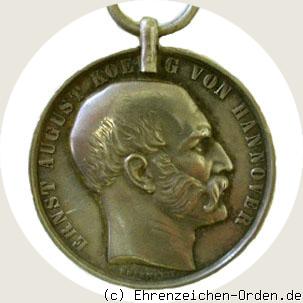
Round gold medal with raised border. An elongated eye with a ribbon ring is attached from above. The name of the leper is carved in capital letters on the rim.
Front side:
- On the margins is the inscription: - ERNST - AUGUST - KOENIG - V.- HANNOVER. -.
In the - center is a large portrait of the king with a mustache and beard.
- Under the neck, the section is small - BREMER F. - (stamping cutter).
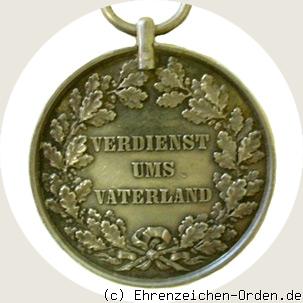
Downside:
- Along the edge is a wide oak-leafy wreath with fruits tied below with a double loop.
- In the included box, a 3-line enlarged font in capital letters:
- - MERIT -/- UMS -/- FATHERLAND -.
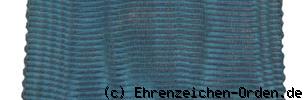
Tape:
.
 King Ernst Augustus Gold Medal (Big Head) 1846
 King Ernst Augustus Gold Medal (Big Head) 1846
Established:
June 5, 1841 by King Ernst Augustus
Data:
- Material: Gold
- Size: 36mm
- Weight: 35.5g
estimated collector price:
3300 – 3500 €

 Awards of World War II