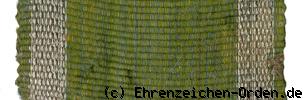
German Awards - Gold Medal for Arts and Sciences with Crown since 1891
Duke Ernst I of Saxon Altenburg established the Medal for Art and Science on December 30, 1874. The medal was awarded in gold (silver gold) and in silver, with and without a crown. Medals were awarded for special services and outstanding achievements in the field of art and science. No bylaws or awarding regulations were passed. Rewarding with a crown should be considered the highest degree.
The duke initially wanted, as in Saxony, to establish an honorary cross in Coburg and Gotha. However, then he decided on a medal. The stamps of the medal were made by Professor Ferdinand Helfricht. The crowns were in place and gilded and attached if necessary. This was taken up by the court jeweler Willy Ganssen.
During the reign of Duke Ernst I, 2 options for minting medals were granted. The 2nd variant was used from 1891. Professor Ferdinand Helfricht produced new facade stamps corresponding to the medals for the merits of the Duchy of Saxe-Ernestine Order. The 1st version of coinage is distinguished by a double jaw beard of the duke. In the 2 shown here. In this version, the portrait has only a beard visible on one side.
Emperor William II. received a special decoration in gold with a crown studded with precious stones. For the 1st coinage, award numbers are given. I don't know about the second form. Arts and science awards were generally treated very sparingly, and medals are very rare in all variants.
Round medal made of gilded silver (gilding is mostly passed here) with a raised border. Above is an ordinary ear, to which a gilded, 5-tuberous crown is movably attached. A ribbon ring passes through the imperial crown apple.
Front side:
- On the margins is the inscription: - ERNST - HERZOG - ZU - SACHSEN - ALTENBURG -.
- Portrait of Duke Ernst I with a one-sided beard.
- Under the neck there is a small section of the stamp - HELFRICHT F.-.
Downside:
- Along the edge is a laurel wreath tied from below with a double loop with fruits.
- Consists of 6 groups of leaves on the left and right.
In - the closed field, a 6-line raised inscription:
- - DEM -/- MERIT -/- MIND -/- ART -/- AND - KNOWLEDGE -/- SHAFT -.
Tape:
green 28 mm wide, edges 1 mm, silver side stripes 4 mm.
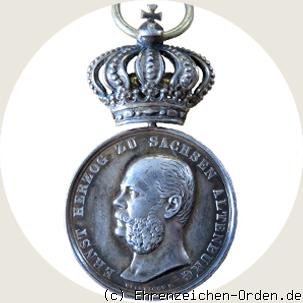 Gold Medal for Arts and Sciences with Crown since 1891
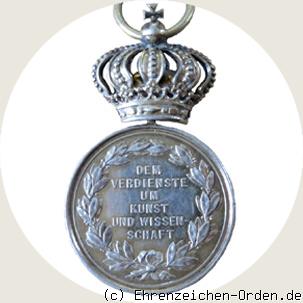 Gold Medal for Arts and Sciences with Crown since 1891
Established:
December 30, 1874 by Duke Ernst I.
Awarded:
1880 – 1891 1. Embossing option
1891 – 1908 2. Embossing option
Data:
- Material: Silver gilded
- Size: 30mm, 20 x 22mm crown
- Weight: about 20g
estimated collector price:
1400 – 1500 €

 Awards of World War II