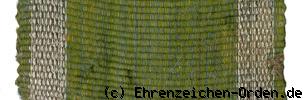
German Awards - Ernst II Gold Medal for Art and Science.
For the first time, medals for art and science were established by Duke Ernst I on December 30, 1874. Medals were awarded for outstanding achievements and services in the field of arts and sciences. Medals were divided into 4 levels or classes: Gold Medal with Crown, Gold Medal, Silver Medal with Crown, and Silver Medal. During the reign of Ernst I, 2 different options were granted. In 1891, medals with a new front side came to the award, corresponding to the stamp of the ducal Saxe-Ernestine medal for the merits of the Order of the House. Stamps under Ernst I belong to Professor Ferdinand Helfricht.
After Ernst II took office. The stamps of the medals were cut. The project was provided by Julie Gente from Leipzig, who won the design tender. The medals were made by Glaser und Sohn in Dresden. 50 gold medals were delivered, some of which were decorated with crowns. The new medals are slightly larger, 33 mm instead of 30 mm, and matte gilded. Old crowns continued to be used. Medals are a rarity.
Round medal made of matte gilded silver without embossed edges. Above is a soldered ordinary eye with a ribbon ring.
Front side:
In the - center of the picture is a portrait of Duke Ernst II.
- Along the edge about 2/3 above the inscription: - ERNST - II - HERZOG -
- - FROM - SAXONY - ALTENBURG -.
- On the cervical area - GENTHE - artist's signature.
Downside:
- Along the edge, a laurel wreath with fruits tied from below, open from above.
- In the included field, a 6-line enlarged font:
- - DEM -/- MERIT -/- MIND -/- ART -/- AND - KNOWLEDGE -/- SHAFT -.
Tape:
green 36 mm wide, edges 1 mm, silver side stripes 4 mm each.
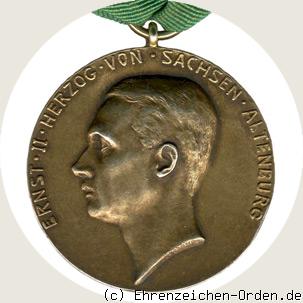 Obverse: Ernst II
 Gold Medal for Art and Science.
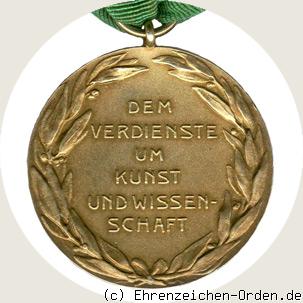 Downside: Ernst II Gold Medal for Art and Science.
Established:
December 30, 1874 by Duke Ernst I.
1909 - portrait of Duke Ernst II.
Data:
- Material: Silver gilded
- Size: 33mm
- Weight: 16.6g
estimated collector price:
350 – 400 €

 Awards of World War II