German Awards - Badges of Honor for Private Service Employees (Senior Line)
The medal was established by Prince Henry XXII. March 28, 1900. This badge of honor was awarded to employees, workers and employees in private services. Persons who, after reaching the age of 20, were 30 years old, were in the same official relationship and served without charge. The medal was not refundable after death. Since 1918, medals began to be made of bronze iron. Court jeweler Riek delivered 300 medals. How many of them were issued is unknown. Source: J. Nimmergut, Deutsche Orden und Ehrenzeichen bis 1945, vol. II, 1997.
Round medal made of dark bronze with a raised border. Above is a soldered ordinary eye with a ribbon ring.
Front side:
- Along the edge along 2 wide oak deciduous branches with acorns to the wreath.
- They are connected from below by a double loop and open from above.
- In the included field above the 2-line - FOR -/- LOYEAST -.
- At the height of the word loyalty bent in a semicircle down - SERVICE -
Downside:
- Along the edge along 2 wide oak deciduous branches with acorns to the wreath.
- The branches are slightly thinner than on the front side.
- They are connected from below by a double loop and open from above.
- In the nested field, double, mirror and rough letters are located in the center:
- - F R - including the Roman number 22 - XXII -, a soaring crown above it.
Tape:
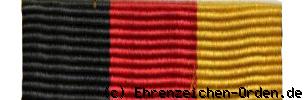
- Width 30 mm, stripes black/red/yellow 10 mm each.
- Women on black ribbon.
.
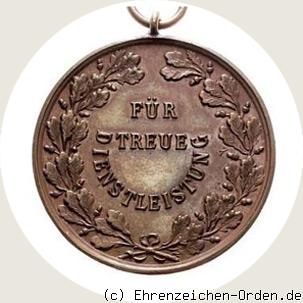 Obverse: Badges of Honor for Private Service Employees (Senior Line)
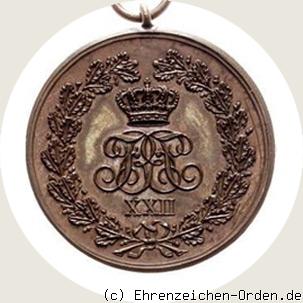 Reverse: Badge of Honor for Private Service Employees (Senior Line)
Established:
March 28, 1900, Prince Henry XXII.
Data:
- Material: Bronze
- Size: 30mm
- Weight: about 11g
estimated collector price:
160 - 180 € in bronze
130 - 150 € zinc bronzed
 Awards of World War II