German Awards - Badges of Honour for Male Servants and Workers
The badge of honor for male servants and workers was established on October 20, 1896 by Prince Karl Gunther von Schwarzburg-Sondershausen. Male servants and workers were awarded, who for 40 years in the same official respect faithfully and impeccably served and were distinguished by loyalty to the ruler of the country and love for the fatherland. Periods of service in the army were not considered a break and counted. Servants belonging to the princely house could, unlike others, after 25 years reckon with the badge of honor. The presentation included a diploma. Inspired by the founding in 1895 of the medal "For Fidelity in Labor" in Anhalt, the prince also wanted to establish an honorary badge for many years of service and was guided by the Anhalt medal in design, as well as in his diploma. On May 9, 1901, the prince presented another oak foliage with the number of years on it 50 to 50 years of service, as well as oak foliage with the number 60 for an unknown time. They were suspended between the medal and the ribbon ring. With a number of 50, only 69 medals were awarded, and with a number of 60 - only 4. The supplier of the medals was the court jeweler Hugo Bur from Sondershausen and the diplomas were printed by the Yevpel court book printing house. A total of 346 medals were awarded. They are non-refundable.
Round silver medal with raised border. Above is a regular eye with a ribbon ring.
Front side:
- On the margins is the inscription: - KARL - GÜNTHER - FÜRST - Z - SCHWARZB. - SONDERSHAUSEN -.
In the - center is a portrait of Prince Karl Gunther.
Downside:
- Along the edge open from above is a light wreath of oak leaves with fruits.
- Below it is tied in a loop.
- The wreath consists of 7 groups of leaves on both sides.
- A silver stamp is carved under the loop - 990 -.
In - the captured field, the 4-line font at break increases:
- - For -/- Fidelity/- in - Work -/- Work -.
Tape:
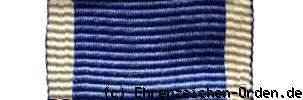
26 mm blue with white edge strips of 2.5 mm.
.
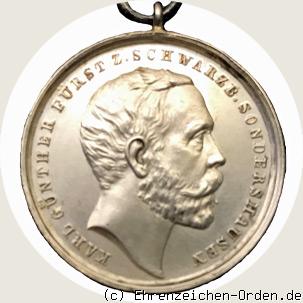 Obverse: Badges of honour for male servants and workers
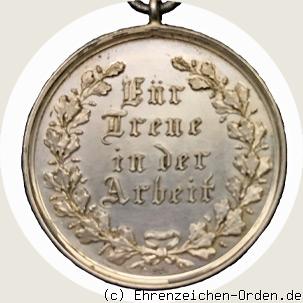 Reverse: Badge of honour for male servants and workers
Established:
October 20, 1896 Prince Karl Gunther
Data:
- Material: Silver
- Size: 30mm
- Weight: 12.2g
estimated collector price:
140 – 170 €

 Awards of World War II