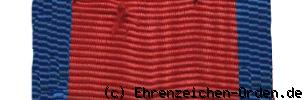
Awards of Germany - Insignia of the 2nd class of 1839
The order was established on September 9, 1833 by King William I of Württemberg. Officers, non-commissioned officers and soldiers were awarded for many years of military service without charge. Officers after 25 years and non-commissioned officers and soldiers after 20 years of service were awarded the Badge of Honor. An active service was counted, which should not have been interrupted for more than a year. The war years were counted twice. On the other hand, the time spent in cadet institutions and officer education in the respective schools were not counted, as well as the time spent in foreign armies. On May 27, 1839, the statutes were changed. Now relatives who were not part of the combat detachment could also be awarded. Among them were representatives of the Ministry of War and the military administration. The terms of the loan have been clarified. Class 2 porters received benefits as employees. The 1st class was a bronze gilded cross with a partially enameled circulation. Shown here 2. The class was a cross made of silver, which had overlays made of gold. The first form of badges of honor has arched, smooth backs without a medallion as a characteristic feature. The medallion is attached with 3 rivets, which can be seen on the reverse. 2. form from 1850 has a smooth, flat back side also with 3 rivets. The first service awards are very rare and subject to return.
Silver cross. Cruciform arms with raised, smooth edges in front. The insides are finely indented. In the center there is a riveted round medallion with a raised border, the circulations are gold. The back of the cruciform shoulders and the middle are arched and smooth. On the upper cruciform shoulder, a parallel eye is soldered, through which an elongated ribbon ring passes.
Front side:
- Round, gilded medallion with raised smooth border. The base is finely indented.
- Along the edge is a raised, gold and tied from below laurel wreath with fruits.
- The wreath consists of 5 groups of leaves with 3 leaves on the left and right.
In - the surrounded field in the middle is a golden, Gothic letter - W - for Wilhelm.
Downside:
- Cruciform brackets and the middle part are silver vaulted and polished.
- Recessed 3 rivets are visible on the middle part.
- 2 at the top left and right, 1 at the bottom at the end of the cross.
Tape:
red 37 mm wide, edges blue 7 mm.
Photos of www.Team-Militaria.de
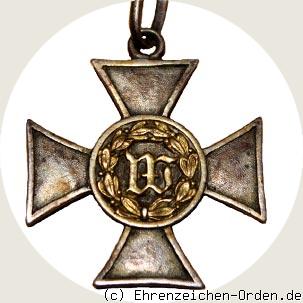 Front: 2nd Class insignia 1839
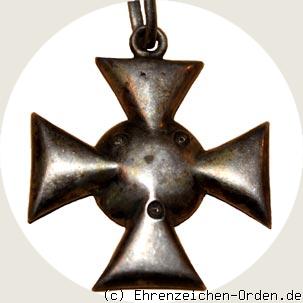 Reverse: 2nd Class insignia 1839
Established:
September 9, 1833 by King William I.
Data:
- Material: silver, gold
- Size: 35mm
- Weight: about 19g
estimated collector price:
750 – 800 €

 Awards of World War II