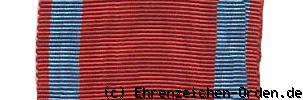
Awards of Germany - 1st degree insignia for 30 years of 1850
The foundation of the insignia dates back to 1833, when King William established the first form of crosses on September 9. Previously, chevrons (corner stripes) were worn after 6 and 12 years 2 stripes. The cross was awarded to officers after 25 years and non-commissioned officers and soldiers after 20 years of loyal service. Active service without a training period was counted. The war years were doubly counted. Since 1839, military officials in the administration and the ministry could also receive honorary badges. In 1850, the charter was changed. The terms of service for non-commissioned officers were changed to 18 years for 2nd class and 30 years for 1st class. In 1850, seniority badges in the form of buckles were introduced for non-commissioned officers and soldiers, and crosses were awarded only to officers. The shape of the crosses was also changed. The crosses are slightly curved inwards at the ends, and the backs are smooth. Versions with a larger and smaller middle medallion were produced. Gold and partially enameled middle shields were riveted at the back. The size varies from 36 mm (large central shield) to 34 mm (smaller shield). Pieces of gilded white metal are considered untimely.
Gilded bronze cross. Cruciform brackets in front with raised smooth edges. The inner sides are finely indented. The backs are smooth. The central shield of the front side is made of gold, partially enameled and fixed on the back with 3 rivets. On the upper cruciform shoulder is a soldered ordinary eye with a ribbon ring.
Front side:
- On the golden central shield in the middle, the letter - W - is in fractional font.
- Surrounded by a green enameled laurel wreath. The fruits are colored red.
Downside:
- Smooth and gilded. On the middle part there are 3 rivets.
Tape:
red 37 mm wide, edges 1 mm, side stripes blue 4 mm. .
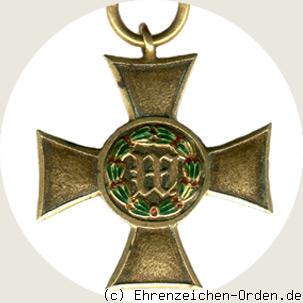 Front side: 1st class insignia for 30 years 1850
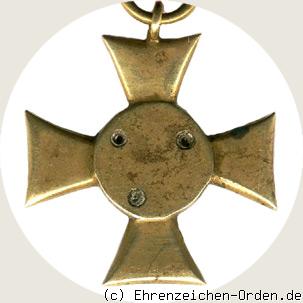 Reverse: 1st class insignia for 30 years of 1850
Established:
December 18, 1850 by King William I.
Data:
- Material: bronze, gold, enamel
- Size: 34mm
- Weight: 12.4g
estimated collector price:
730 – 760 €

 Awards of World War II