German Awards - Karl Olga Bronze Medal
The Carl Olga Medal was instituted on 16 June 1889 by Queen Olga with the consent of King Charles. The medal had 2 classes of silver and bronze, and the bronze medal of Karl Olga shown here was awarded less often. On the occasion of the 25th anniversary of the reign, this badge of honor was approved by King Charles. His wife, Queen Olga, was a defender of the Württemberg Medical Union of the Red Cross. The Queen also shouldered the costs of the awards. Proposals for awards were passed from the medical association to the queen, and from the latter to the king. The king reserved the award. Men, women and virgins who earned the care of wounded and sick warriors in the service of the Red Cross were awarded. King Charles's successor, King William II, determined the re-awarding in honor of the founder and changed the provisions on awarding. As a result, the medal was attached to the Order of Olga. From now on, the medal was the lowest level of the order and was awarded in cases that did not yet justify the award of the order. Since 1905, the possession of a silver medal was considered a prerequisite for awarding the Order of Olga. In 1916, the award was discontinued in favor of the Charlotte Cross. The stamp cutter was C. Schwenzer, royal mint of Stuttgart. The mint was also the Württemberg Royal Mint. The Red Cross was established later. The number of products is about 600. There are crosses with translucent hatching and opaque, red enamel. Source: J. Nimmergut, Deutsche Orden und Ehrenzeichen before 1945, vol. IV, 2001.
Round bronze medal with raised border. Above is a riveted red enameled Geneva cross. (Here the enamel was replaced) On the back of the cross is a vertical ribbon eye.
Front side:
- The edge is wide, inside bounded by a line.
- At the top, it is interrupted by a silver Red Cross.
- On it is an elevated font starting to the right of the cross:
- - KARL - AND - OLGA - KING - AND - QUEEN - FROM - WÜRTTEMBERG -
In - the closed field are portraits of the couple facing right.
- In the foreground is Queen Olga, followed by the half-closed King Charles.
Downside:
- The edge is wide, inside bounded by a line.
- It has a raised font starting to the right of the rivet:
- - FROM - DER - PROTECTORIN - DES - WÜRT.- MEDICAL ASSOCIATION - FROM - RED - CROSS -.
- In the included field, four-line font: (less) - FOR -/- (more) MERIT -/
- - (smaller) UM - DAS -/- (larger) RED - CROSS - below it is a pointed 6-ray star.
Tape:
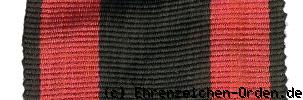
- black 25 mm wide, edging 1 mm, red side stripes 5 mm.
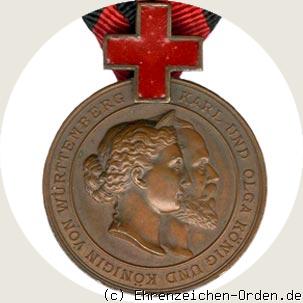 Front side: Karl Olga bronze medal
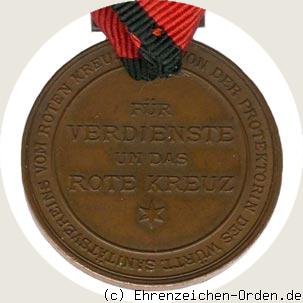 Reverse: Karl Olga Bronze Medal
Established:
June 16, 1889 by Queen Olga and King Charles
Data:
- Material: bronze, enamel
- Size: 27.6mm, cross 12.8mm
- Weight: about 12g
estimated collector price:
370 – 400 €

 Awards of World War II