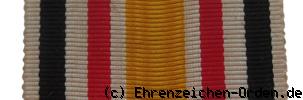
Germany Awards - 1901 Chinese Commemorative Fighter Coin
A commemorative Chinese coin was issued on 10 May 1901 by King and Emperor William II. donated. The medal was awarded in recognition of valor and resilience during hostilities in East Asia. The defining period was from 30.05.1900 to 29.06.1901. The medal was awarded in bronze to fighters and in non-formations. This commemorative coin was awarded to all officers and soldiers, medical officers, marine engineers, officials, as well as witness officers and fireworks who participated in hostilities in China or were already there at the outbreak of hostilities. Equally entitled to voluntary care were persons who were on the battlefields or in field hospitals and hospital ships, German guards in Beijing and Tianjin, and not the Chinese who were at that time in the German embassies. The project was developed by the emperor himself, Professor W. Schott, Berlin. Medals in Stuttgart were minted by Wilhelm Mayer and Franz Wilhelm. The number of copies sold exceeds 40,000.
Battle stamps for fighters in the corresponding battle were presented to the commemorative coin. This distinguished between the Navy, Army and Battle Stakes for both. The following sleepers are known: TAKU, SEYMOUR-EXPEDITION, SEYMOUR-EXP., TIANJIN, BEIJING, PEITANG-FORTS, LIANG-XIANG-XIAN, KAUMI, TSEKINGWAN, KALGAN, HUOLU, KITCHOU, HOPHU, FOUPHING and NAN-HUNG-MEN. Unofficial bonds were also minted. Source: J. Nimmergut, Deutsche Orden und Ehrenzeichen before 1945, vol. IV, 2001.
The round bronze medal (also gilded) on top has a broadening of the edge with a hole for placing a small ring, on it a ribbon ring.
Front side:
- Around the edge is a round circular laurel wreath.
- On the right is a flying eagle with a crown, in its paws a Chinese dragon half lying along the edge.
- The tail of the dragon is S-shaped above the wings of the eagle, the muzzle is high to the wing.
Downside:
- Central under the imperial crown with ribbons on both sides, Gothic - W -.
- Around the edge is a round circular laurel wreath.
- Attached is the inscription: - DEN - SIEGENEN - STREITEN -, under W: - 1900 - CHINA - 1901 -.
Tape:
- 35 mm wide, white edges 2 mm, side stripes black/white/red 3 mm each, central stripes yellow 8 mm with side white stripes 2 mm each.
.
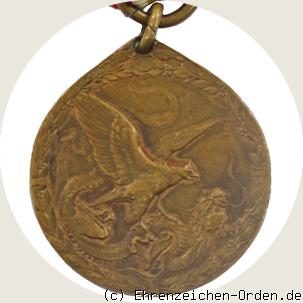 1901 Chinese commemorative coin for fighters
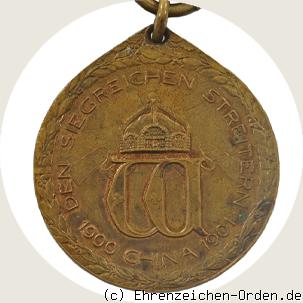 Reverse: commemorative Chinese coin for 1901 fighters
Established:
May 10, 1901 by the emperor and king William II.
Data:
- Material: Bronze
- Size: 32.6 x 35.1mm
- Weight: 18.6g
estimated collector price:
100 - 120 € in bronze
90 - 100 € in copper gold
80 - 100 € in zinc gold

 Awards of World War II