Germany Awards - Dibic Cross 2. That is sick
The Dibich Freikorpus was formed on April 1, 1919 by Lieutenant Colonel Freicherr Karl Heinrich von Dibich. Formed mainly from the remnants of the Saxon Landwehr. Among them are the MG company, parts of the Jaeger squadron on horse No. 8. The composition is indicated from 38 officers, 210 non-commissioned officers and 700 soldiers. They were structured into 4 infantry companies, an artillery battery and a reconnaissance detachment. About 600 horses, 120 cars and 93 bicycles. The volunteer corps was used mainly in Lithuania/Courland for the protection of communication lines, such as railways in the area. Later it was also used in the border guard in Silesia. It was disbanded on 18 December 1919 or in April 1920. The volunteer corps was included in the 102nd Reichswehr Infantry Regiment.
The commander, Lieutenant Colonel von Dibich, established a total of 5 awards: the Dibich cross was awarded in the 2nd grade, the Malplake star, the ladies' loop to the star and the medal for good care of horses. The Dibich Cross was awarded for valiant behavior in the freakorps. Malplake's star was awarded for services to the Free Corps. The presentation was attended by a certificate of ownership signed by Dibich. The only known manufacturer is Paul Meybauer, Berlin. All awards are very rare and are popular with counterfeiters who make copies to the detriment of the collector.
Eight-pointed cross made of gilded non-ferrous metal. Front and back with embossed round central screen. Cruciform hands are sheathed in gold and enameled in black. 2 crossed golden swords pass through the center. Paired rods in the form of 3 sheets. Between the tops of the upper cruciform sleeve is an ornamented agraf. A small corrugated ring with a ribbon ring passes through them.
Front side:
- Golden central shield (12 mm) with a raised edge. The midfield is perfectly drawn.
- It houses 3 curved wings. From above, 2 wings face each other, feathers outward.
The 3rd - wing in the center down, feathers directed to the right.
Downside:
- Golden central shield (12 mm) with a raised edge. The midfield is perfectly drawn.
It - increases the year - 1919 - including the horizontal line.
Tape:
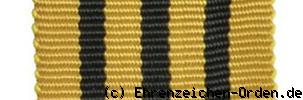
yellow 25 mm wide, edges 5 mm, 3 stripes black 2 mm each, intermediate stripes yellow 3 mm.
.
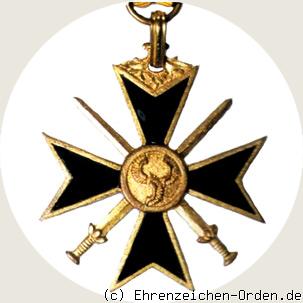 Front side: Dibic cross 2. That is sick
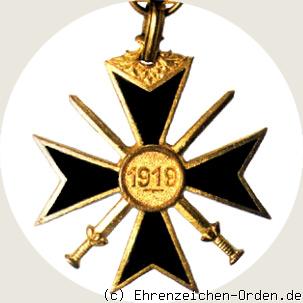 Reverse: Dibic cross 2. That is sick
Established:
circa 1919, Lt. Col. Freiherr Karl Heinrich von Diebitsch
Data:
- Material: non-ferrous metal with gilding, enamel
- Size: 41mm x 45mm, swords 41mm
- Weight:
estimated collector price:
270 – 290 €

 Awards of World War II