German Awards - Air Force Civil Aviation Commander Badge
On April 1, 1936, Hermann Göring, Commander-in-Chief of the German Air Force, established the civil Aviation Leader badge along with a civilian airborne radio sign. This was published in the "Luftwaffenverordnungsblatt" on 6 April 1936, item 420. It was awarded to civilian pilots who served in the Air Force and continuously served as pilots or flight instructors for at least 1 year. Pilots were considered B2 ticket takers, including K 1. The award had to be applied to the Imperial Ministry of Aviation. Either the competent flight school or the competent department. The presentation took place with an act of possession. The mark was not refundable after an honorable farewell. When moving to the Air Force, it was necessary to remove the badge. It is very likely that with the outbreak of World War II, all civilian aviation leaders in service were actively recruited into the Air Force. This gives a very short rental period, and also explains the rarity of badges. Famous manufacturer C.E.Juncker from Berlin. There are also badges without a manufacturer's designation.
Elongated, gilded and front blue enameled non-ferrous metal fastener. On the back is a long pin lying across with reciprocal hooks. In the center is the manufacturer.
Front side:
- The sign consists of 2 wings, which merge into a swastika in the center.
- The swastika is placed on top and gilded.
- The wings consist of 3 rows of feathers covered with gold and enameled blue paint.
- The lower row has 13 feathers, the middle 7 feathers and the upper row of 5 feathers.
- The spring rods are designated and gilded respectively. Above is a solid armrest.
Downside:
- The reverse is smooth and gilded.
- Central stamped 2-line manufacturer - C.E.JUNCKER -/- BERLIN S W -.
- The transverse needle is rounded.
Photos of www.Team-Militaria.de
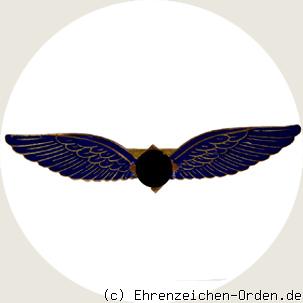 Front side: Civil badge of the Air Force aircraft commander
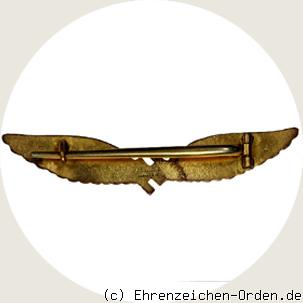 Reverse side: Civil badge of an Air Force aircraft commander
Established:
April 1, 1936 Hermann Goering
Data:
- Material: non-ferrous metal with gilding, enamel
- Size: 80.3mm x 12.75mm
- Weight: 15g
estimated collector price:
1500 – 1600 €

 Awards of World War II