German Awards - Potsdam Mark 1932
This sign was established on the occasion of the 1st National Socialist Reichsyugendtag on October 1 and 2, 1932 in Potsdam by Reichsyugendführer Baldur von Schirach in August or September 1932. The sign was produced or sold for members and spectators from 1932 to 1945. The price was 1 mark. Bronze and silver (silver-plated) badges were allegedly issued. Participants must have silver badges, and spectators must have bronze badges. However, time witnesses also point to exceptions or deviations. From 1935, the badge could be worn on HJ or SA uniforms. In 1932, the Hitler Youth had about 34,000 members. The number of awards or circulations varies from 70,000 to 115,000 pieces. Because of the sale items, the exact number should also be difficult to determine. A well-known manufacturer is F.Hoffstätter from Bonn. It is also possible that other manufacturers produced their brands. The project was originally designed by Adolf Hitler, who painted the badge at the 1932 convention. The project was modified by Baldur von Schirach regarding the inscription. Instead of the Imperial Party Congress, Imperial Youth Day now appears. Hofstetter's badges are worn on the reverse side elevated on the left - GES. RIGHT - F. HOFSTETTER, BONN -. The manufacturer's recognizer can also be mounted horizontally under the needle. Non-ferrous, aluminum, and white metal badges are known.
A massive embossed sign of non-ferrous metal of bronze color in the form of a standing rectangular shield. On the back is a vertical pin applied with plates. Sublimely minted the designation of the manufacturer.
Front side:
- Sign with raised, smooth, narrow edge. In the center is a sword.
- The ends of the hilt rise slightly above the edge, the point of the sword protruding beyond the edge.
In the - center of the sword handle is a 3-fold tied oak wreath with a swastika.
- The subsoil of the inner field is fine-grained. The bottom tape with the year number is smooth.
- Above, separated by a handle, on the left - N - and on the right - S -.
- Left next to the blade perpendicular, elevated - I.- REICHS -, right next to the blade - JUGENDTAG -.
- On the bottom ribbon, the font deepens the year, to the left of the blade - 19 - and to the right - 32 -.
Downside:
- A little higher, using plates, dissolve the pin.
- Above the needle - F. HOFFSTETTER - BONN -.
- Under the needle - GES.-.
Photos of www.Team-Militaria.de
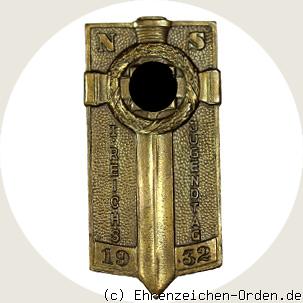 Obverse: Potsdam sign of 1932
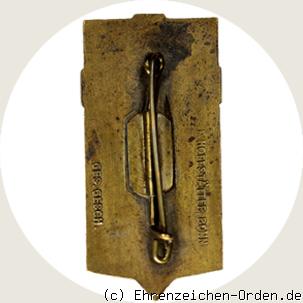 Reverse: 1932 Potsdam sign
Established:
August/September 1932 - Reichsführer youth Baldur von Schirach
Data:
- Material: non-ferrous silver-plated metal
- Size: 48.5mm x 22.5mm
- Weight: about 11g
estimated collector price:
120 – 140 €

 Awards of World War II