German Awards - HJ Gold Badge of Honour (award)
The golden badge of honor of HYU (Hitler Youth) was established around August 1934 by the Reichsügendführer Baldur von Schirach. There is disagreement over the exact time of foundation. The occasion was Imperial Youth Day in October 1932. Members of HJ, BDM (German Girls' Union) and DJ who were already in one of these organisations before Imperial Youth Day at 2.10. 1932 in Potsdam, were to receive a special badge in the sign of the "Old Guard." An honorary card was issued for the badge, which, on the one hand, gave the right to wear, and on the other, fixed the date of entry and the award number. It has always been used as a gift. In 1941, expanded provisions were adopted on awarding the newly annexed and occupied territories. They regulated the right of "youth from Volksdeutsche" in the relevant organizations of the occupied countries. The badge of honor was awarded in large quantities, from about 120,000 to 130,000 pieces, with a smooth border. Badges were often lost and replaced by secondary ones - B. Then, starting in 1939, a needle fuse (other mount) was installed. A special form is a sign with oak foliage. It was presented to high figures of the HYU and foreign and foreign figures. Provision of approximately 400. This sign was also made of gold in a very small number of copies. Since 1942, presumably, a special level with diamonds and rubies was awarded. Famous manufacturers were: M1/120 W. Deumer, M1/122 I. Deutschbein and M 1/78 Paulmann + Crone. Source: J. Nimmergut, Deutsche Orden und Ehrenzeichen bis 1945, vol. IV, 2001.
A diamond-shaped gilt bronze sign. The edges (2 mm) are smooth and golden. The inside is red and white enameled. Red parts with glass enamel and translucent puncture. At the back is a vertical pin.
Front side:
- Mitiig on a gold background is a black enameled swastika placed on top.
- The background is divided into 4 rhombuses. The upper and lower rhombus are covered with red enamel.
- Through the enamel, you can see a puncture. Medium rhombuses are white.
Downside:
- Smooth and gilded. REM stamp and manufacturer 15.
- In the center a little lower and parallel to the needle, the serial number is 13232 -.
Photos of www.militaria-berlin.de
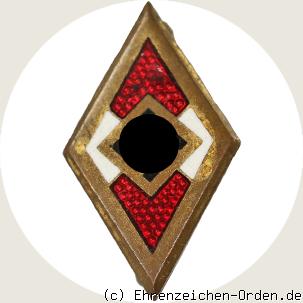 Front: HJ Gold Badge of Honour (award
)
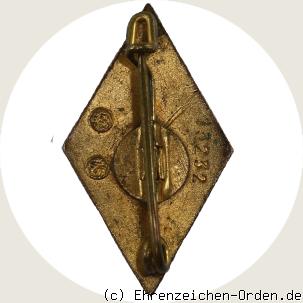 Reverse: HJ Gold Badge of Honour (award)
Established:
August 1934, Reichsügendführer Baldur von Schirach
Data:
- Material: Bronze gilded
- Size: 28.3 mm x 17.0 mm
- Weight: about 3.7g
estimated collector price:
260 – 300 €

 Awards of World War II