German Awards - Traditional Gau Mark Food in Silver
The traditional Gau Essen sign was established in 1935 by Gauleiter Joseph Terboven. The occasion was the 10th anniversary of the founding of Gaus Essen NSDAP. Joseph Terboven joined the NSDAP back in 1923 and participated in the Hitler putsch of Ludendorff on November 8-9, 1923 in Munich. In 1925 he founded the local Essen group, was the head of the SA, and already in 1928 he became a Gauleiter. Since 1930 he was a deputy of the Reichstag, and in 1935 he became chief president of the Rhine province. After the occupation of Norway, he became Reich Commissioner in Oslo on April 24, 1940. At the end of the war he committed suicide.
It was made of gold and silver. Gold awards were provided only for special occasions or higher persons. Only 4 awards with a gold badge of honor are known. In 1937, Adolf Hitler, Reich Chancellor, Hermann Goering, became Prime Minister of Prussia and Commander-in-Chief of the Air Force, Dr. Robert Ley became the head of the Reich organization, and in 1939 Heinrich Unger became deputy Gauleiter in Essen. As a manufacturer, Hoffstetter from Bonn is known. The silver badge of honor depicted here was awarded to all members of the GAU NSDAP who had the Gold Badge of Honor of the NSDAP, as well as to persons who earned exceptional services to the NSDAP in the GAU. Badges in the same design were also made of gilded aluminum. However, they are identified as meeting badges rather than traditional gau badges. Source: J. Nimmergut, German Orders and Insignia until 1945, vol. IV.
Plastic badge made of silver. The back side is smooth with a vertical needle system. The average silver ounce is 935 -.
Front side:
In the - center is a vertically standing sword with a narrow parrying rod and after
- angled corner ends. A swastika placed on top deepens on the handle of the sword.
- Behind the crossed sword, a blow and iron are arranged.
- On the hardware, on the left, the year deepens - 1925 -.
- On the strike, on the right, the number of the year deepens - 1935.
Downside:
- Smooth and silver. Vertical - pin with fuse.
- The average silver ounce is 935 -.
.
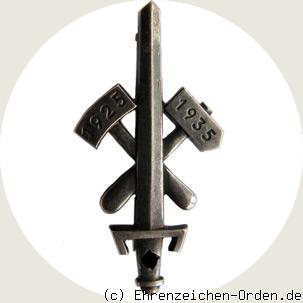 Obverse: Gau traditional food sign in silver
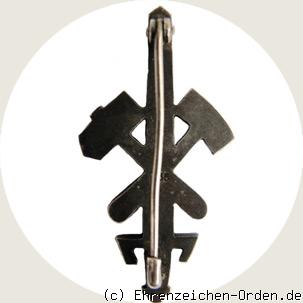 Reverse: Gau traditional food sign in silver
Established:
1935 Gauleiter Josef Terboven
Data:
- Material: Silver
- Size: 52mm x 30mm, impact/iron approx 12mm x 32.5mm
- Weight: 4.6g
estimated collector price:
1800 – 2000 €

 Awards of World War II