Germany Awards - Gdańsk Cross 1. That is sick
Gauleiter Albert Forster, as head of state of the Free City of Danzig, established the Gdansk Cross in 2 classes on August 31, 1939. The latter appointed himself head of state in August 1939, replacing Senate Chairman Arthur Greiser. She was awarded for services in the construction of the NSDAP in Gdańsk Gau, the Nazi state of Danzig, as well as for the construction of the defense of Gdańsk before the outbreak of war in September 1939. The 1st class cross shown here was a nodal cross. 2nd class was worn on the ribbon. After being included in the German Empire, it was equated with the awards of other German states. The project was developed by the Berlin imperial set designer Benno von Arent. The sole manufacturer is Hürse, Berlin. The Gdańsk Cross was a peace award. Rewarding servicemen was possible if they deserved merit in creating a secret army in Danzig before the outbreak of World War. Most of the awards took place on October 24, 1939, on the Day of Traditions of the National Socialists in Gdansk. Gdańsk Cross 1. In total, the class was awarded 88 times. 2 options are known. The first with a double decorative line on white enameled cruciform arms and shown here, with a wide inner board. Both claims appear to be corroborated. Silver crosses with gilding are most likely private items. Source: J. Nimmergut, Deutsche Orden und Ehrenzeichen before 1945, vol. IV, 2001.
Elongated plaster cross made of gilded bronze with white enameled cross-shaped sleeves on the front side. On the front side there is a gold lining. The reverse is smooth and gilded with visible rivets. Vertically - a pin with a reciprocal hook.
Front side:
- The cross shoulders are narrowly golden borders. Inside is another gold rim.
- This central one has a recessed groove. In the center to the upper cruciform sleeve is a golden base.
- It consists of 2 crossed crosses crowned with a five-petalled crown.
- They are taken from the coat of arms of Gdansk. The lower cross is centered on a white cross.
Downside:
- Smooth and gilded with a vertical pin with a mating hook.
- Central and above the upper spider, through a raised tongue, 2 rivets with which the stand is attached.
- Under the response hook 2-line, the manufacturer's designation increases: - B.v.A. -/- sleeve-Berlin -.
Photos of www.Team-Militaria.de
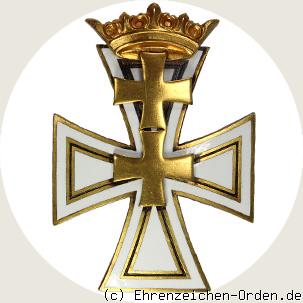 Front side: Gdansk cross 1. That is sick
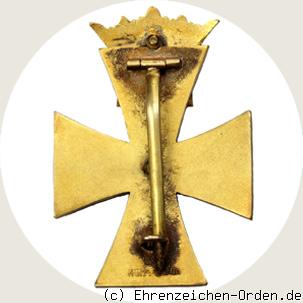 Reverse: Gdansk Cross 1. That is sick
Established:
August 31, 1939 Gauleiter Albert Forster
Data:
- Material: gold-plated bronze, enamel
- Size: 61.45mm x 42.96mm, crown 29 x 13mm
- Weight: 36.95g
estimated collector price:
3000 - 3200 € in bronze with gilding
3100 - 3300 € silver gilded

 Awards of World War II