German Awards - Order of Merit Knight's Cross 1st Class
Knight's Cross 1. A gold class with painted, multi-piece medallions was awarded between 1815 and 1912. Award data varies. For golden knightly crosses, about 2000 pieces are indicated. For a silver gilded cross about 360 pieces. Knightly crosses with medallions of the 2nd form had a built-in coat of arms and no longer had a raised border. As a manufacturer, Scharffenberg is known in Dresden.
The Order of Merit was established by King Frederick Augustus back in 1815 as a civil order of merit. Initially, the order was divided into 3 classes: the Grand Cross, Komtur and the Knight's Cross. Unofficially, the Civil Medal was considered the 4th class. In 1849, the order was renamed the Order of Merit and expanded to 5 classes. These included the Grand Cross, Komturkreuz 1st Class, Komturkreuz 2nd Class, Knight's Cross and Small Cross. For this, he received gold and silver medals. Foreigners were awarded the order with a different inscription on the reverse. (For merit) In 1858, the Small Cross was renamed the Honorary Cross. Swords for military merit were instituted for all classes in 1866. The swords on the ring were presented by King Johann only in 1870 for holders of the "Mir" class cross, who subsequently received military merit or for those who received a higher class but previously had lower-class military decoration. In 1876, there was a change in statutes. The knight's cross was divided into the 1st and 2nd. The class is divided. The honorary cross was no longer awarded and could be exchanged for the Knight's Cross of the 2nd class. For the gold medal "For Merit," the cross "For Merit" was established. An exchange was also possible. The new 6 classes were: Big Cross, Komtur 1st and 2nd. Class, 1st and 2nd class knights. Class and Merit Cross. In 1891, as a final extension, the golden crown was given to the Grand Cross and Comtur. The breast star of the Grand Cross became 8-ray. Source: Nimmergut, Deutsche Orden und Ehrenzeichen until 1945, Bd.3.
Eight-pointed cross made of gold. Front and back sides with superimposed round medallion. The cruciform arms are painted in white enamel and gold border. Between the cross-shaped sleeves are green enameled segments in the form of a diamond crown. Transverse lug with bandage ring is soldered between tops of upper cross.
Front side:
- Medallion with raised, gold, keeled rim. The inner field is enameled.
- Along the edge is a gold overprint on top, separated by a gold, 5-beam royal crown:
- - FRIED. - AUG. - K. - V. - SAXONY - D. - 7. - JUN. – 1815. -.
In the - center is a black-golden-green painted coat of arms of Saxony.
Downside:
- Medallion with raised, gold, keeled rim. The inner field is enameled.
In - the center of the field there are 4 lines drawn in black: - FOR -/- MERIT -/- AND -/- LOYALTY -
- Along the edge is a green, painted, circulating wreath of oak leaves.
Tape:
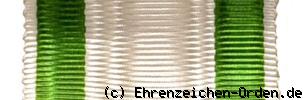
- 35 mm wide, white edges, with 7 mm green side stripes
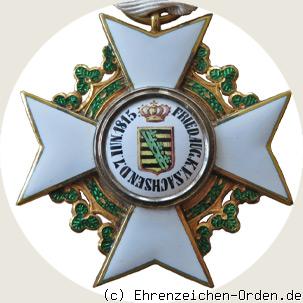 Obverse: Order of Merit Knight's Cross 1st Class
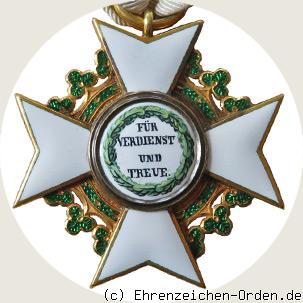 Reverse: Order of Merit Knight's Cross 1st Class
Established:
June 7, 1815 by King Frederick Augustus
Data:
- Material: gold, enamel
- Size: 41mm
- Weight: about 17g
estimated collector price:
2000 – 2200 €

 Awards of World War II