Awards of Germany - Order of the Württemberg Crown Knight's Cross with Lions
A knight's cross with lions between the cross sleeves has been awarded since 1892. Knight's crosses no longer had a crown and could now be awarded as a special award with lions between the cross sleeves.
With the last new revision of the statutes in 1892, the silver medal "For Merit" disappeared. The Cavaliers of Honor crosses were converted to pinfall. The knight's cross has undergone some changes since its foundation. Already in 1864, he received the crown as a special award. Swords were presented to all classes in 1870, and a knight's cross in the 1st and 2nd. The class is divided. Already in 1886, the 2nd class was no longer awarded and the Knight's Cross became the Honorary Knight's Cross (with a crown). Knights became the owners of the 2nd class.
The Order of the Württemberg Crown was established by King William I on September 23, 1818. To this end, the Order of the Golden Eagle (1807) and the Civil Order of Merit (1806) were replaced by a new order. Initially, the order had 3 classes: a large cross, a komtur and a knight. It was accompanied by a gold and silver medal for merit. Bearers were required to wear the order in their own name and coat of arms. Bourgeois carriers were elevated to personal nobility. Only the king himself could determine the inclusion in the order. Since its expansion in 1889, the order consisted of 5 classes. The new classes were the Grand Cross, the Komtursky Cross with a breast star, the Komtursky Cross, the Honorary Knight's Cross and the Knight's Cross. Received awards with swords, for military merits, were allowed to continue wearing from 1890 even when receiving the highest class. Since 1913, the award was no longer associated with personal nobility.
Knight crosses with lions meet rotating lions and with lions dressed up and down. Famous manufacturers were Eduard Föhr, a royal court jeweler, from Stuttgart and F. Steinam, a royal court jeweler, from Stuttgart. Since the knightly crosses were subject to return, the returned crosses were also redesigned. That is, lions and farmers could be processed or supplemented. At the end of World War I, the crosses were made of silver.
Eight-pointed cross made of gold. The cruciform arms are maroon golden and enameled white. Between the cross sleeves are golden lions. Front and rear with separate round medallions. Between the tops of the upper cruciform shoulder there is an agraph with an eye, through which a ribbon ring passes.
Front side:
- Central shield with a wide, red, translucent enameled ring.
- This one, with gold edges inside and out, is webbed.
- On it is a golden inscription: - Fearless - and - trew - below a wavy ornamental touch.
- The enclosed field is enameled in white. Hung a decorated, crowned letter - F -..
Downside:
- Central shield with a wide, red, translucent enameled ring.
- This one, with gold edges inside and out, is webbed.
- On it is a golden inscription: - Fearless - and - trew - below a wavy ornamental touch.
- The enclosed field is enameled in white. A 5-ray gold crown is hung.
Tape:
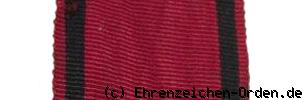
dark red 35 mm wide, edging 2 mm, side stripes black 2 mm.
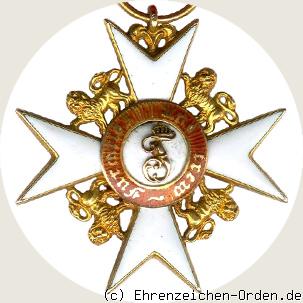 Obverse: Order of the Württemberg Crown Knight's Cross with Lions
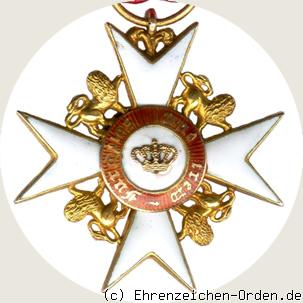 Reverse: Order of the Württemberg Crown Knight's Cross with Lions
Established:
September 23, 1818 by King William I.
1892 Knight's Cross with Lions
Data:
- Material: gold, enamel
- Size: 34.8mm x 33.7mm
- Weight: about 10g
estimated collector price:
2000 - 2200 € in gold
1700 - 1900 € silver gilded

 Awards of World War II