Awards of Germany - Oldenburg Order of House and Merit Komturkreuz
The Komtur Cross was the 3rd class of the Oldenburg Order of the House and Merit. Contrary to the large cross and large comture, the comture was worn without a breast star as a neck decoration. The cross of the order was somewhat smaller than that of the large komture. It was awarded to persons with the rank of colonel, chief forester, secret chief construction council or equivalent official position. Comture crosses were made in 2 versions, differing in size. Smaller crosses measure about 64 x 40 mm. The larger version, on the other hand, is up to 71 x 43 mm. The differences are likely due to different manufacturers and timing. The best known high-end manufacturers were Carl Zell, Hannover, Georg Knauer & Wilhelm Lameyer, Hannover, and Johannes Wohack of Frankfurt am Main. for early crosses. Berhard Dietrich of Altenburg until about 1870. Later supplied Bernhard Knauer, Oldenburg and Lameyer and son, Hanover, to name the most important. Towards the end of the World War, silver gilded crosses were also made.
The Order of Home and Merit was established on November 27, 1838 by Paul Friedrich Augustus and was supposed to remind of the 25-year return of his father. The order consisted of 4 classes for honorary cavaliers and 4 classes for captains: a large cross, a large comture, a comture and a small cross (from 1860 knightly crosses). Attached to the order is a common badge of honor in 3 classes: gold, silver and iron. The large crosses were divided into gold and silver crown crosses in 1841. In 1856, for merits in the war, this award was expanded with 2 swords passing through the center. With a higher talent in peacetime, they were added to the ring. To the Common Badge of Honor 1. The class was awarded a gold crown. In 1883, the General Badge of Honor was renamed the Cross of Honor. In 1903, the Officers' Cross was established between Komtur and Knight's Cross 1. The class stands. Knight's Crosses 2nd Class were split in 1906. Knight's Crosses 2. Class without crown. The last expansion was the Laurel Fund for sword crosses in 1918. In the event of death or promotion, orders were subject to return. The meaning of the dates on the cross sleeves: January 17, 1755 - the birthday of Duke Peter Friedrich Ludwig, July 6, 1785 - entry into the government, May 21, 1829 - the anniversary of the death of the duke, November 27, 1838 - the foundation of the order.
The Komtursky cross without swords was awarded 1126 times. However, the award acts and production numbers differ from each other.
The cross is gold with white enameled cross sleeves and gold edges. In the center, a round medallion with a border is worn on both sides. Angular ear above. Thanks to this, a small corrugated ring to which a movable, golden crown is attached. A ring passes through the imperial apple of the crown, subsequently a double elongated ribbon ring.
Front side:
- A central shield with a gold border outside and inside from the ring.
- Red enameled ring with gold inscription:
- - ONE - GOD - ONE - RIGHT - ONE - TRUTH -
- In the included blue enameled field, the letters - P - F - L - are intertwined
- Nickname Peter Friedrich Ludwig, under the silver crown.
Downside:
In - framed by a gold enameled central shield, the coat of arms of Oldenburg with an ermine mantle and a crown.
- On white enameled cross sleeves - gold dates.
- bottom: - November 27, 1838 -, right: - May 21, 1829 -, top: - January 17, 1755 -, left: - July 6, 1785
-
Tape:
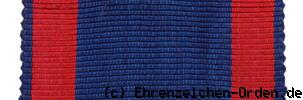
35 mm wide with a red 6 mm wide side strip and a 1.5 mm edge
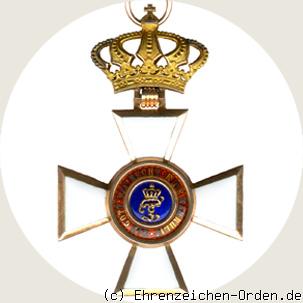 Front: Oldenburg Order of the House and Merit Komturkreuz
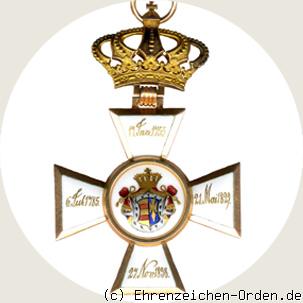 Reverse: Oldenburg Order of House and Merit Komturkreuz
Established:
November 27, 1838 by the Grand Duke Paul Friedrich Augustus
Data:
- Material: gold, enamel
- Size: 41mm x 67mm, crown 27 x 22mm
- Weight: 22.4g
estimated collector price:
1900 - 2200 € in gold

 Awards of World War II