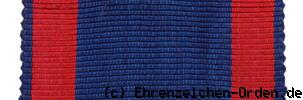
Awards of Germany - Order of the House and Merit of Oldenburg Honorary Cross 1. That is sick
This order was established on November 27, 1838 by Paul Friedrich Augustus and was supposed to remind of the 25-year return of his father. Initially, the order consisted of classes: Grand Cross, Grand Komtur, Komtur and Small Cross (from 1860 knightly crosses). Attached to the order is a common badge of honor in 3 classes: gold, silver and iron. The large crosses were divided into gold and silver crown crosses in 1841. In 1856, for merits in the war, this award was expanded with 2 swords passing through the center. With a higher talent in peacetime, they were added to the ring. To the Common Badge of Honor 1. The class was awarded a gold crown. In 1883, the General Badge of Honor was renamed the Cross of Honor. In 1903, the Officers' Cross was established between Komtur and Knight's Cross 1. The class stands. Knight's Crosses 2nd Class were split in 1906. Knight's Crosses 2. Class without crown. The last expansion was the Laurel Fund for sword crosses in 1918.
Early crosses were slightly smaller and thinner, the diameter of the median shields was 16 mm, later then 18 mm. Honorary crosses of the 1st class were made of gilded silver. Gilded bronze crosses are also known. The number of awards of honorary crosses of the 1st class without swords and crown is about 2000 pieces.
Gilded silver cross. Crosses with raised wide edges. The inner sides of the cruciform sleeves are fine-grained. Front and back with a round central shield (18 mm), on the upper cruciform shoulder a soldered ordinary eye with a ribbon ring.
Front side:
- Round central shield with a relief edge and a wide ring.
- The latter is delimited inwards with a raised edge.
- It has a sublime paraphrase: - ONE - GOD - ONE - RIGHT - ONE - TRUTH -
- Order motto of Oldenburg.
- In the included field, the letters - P - F - L - are intertwined.
- Initials of Duke Peter Friedrich Ludwig. Above it is a sitting crown.
Downside:
- Central shield with raised edge.
- The central coat of arms of Oldenburg is framed on both sides by cloth (cloak )
- This right and left top are tied and inflated in the center of the crown.
Tape:
35 mm wide with a red 6 mm wide side strip and a 1.5 mm edge
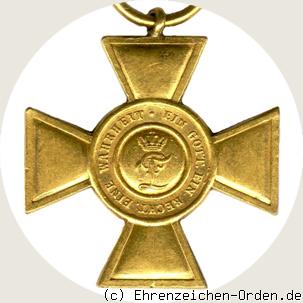 Obverse: Oldenburg Order of the House and Merit Honorary Cross 1. That is sick
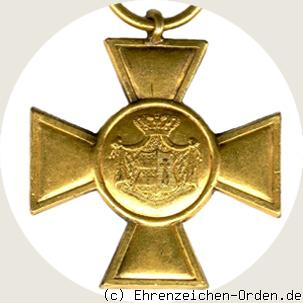 Reverse: Oldenburg Order of the House and Merit Honorary Cross 1. That is sick
Established:
November 27, 1838 by the Grand Duke Paul Friedrich Augustus
Data:
- Material: Silver gilded
- Size: 34mm
- Weight: 7g
estimated collector price:
260 - 280 € silver gilded
180 - 220 € in bronze with gilding

 Awards of World War II