German Awards - Oldenburg House and Order of Merit Grand Cross with Gold Crown
The large gold cross with a gold crown depicted here until 1841 was called only the Great Cross. The first crosses were made of gold. The most famous manufacturers of early gold crosses were the jeweler Karl Zell from Hanover, Georg Knauer and Wilhelm Lameyer from Hanover and Johannes Voak from Frankfurt. Since 1903, they began to be made of silver. In the statutory supplement to paragraph 2 of January 17, 1841, the Grand Cross was divided into 2 tiers. Prior to this, the Grand Cross was called the Grand Cross with a golden crown. The cross, all in silver, was called only the Great Cross. The corresponding breast star was also made of silver. The Grand Cross of the Oldenburg House and Order of Merit was established as the upper class on 27 November 1838. On January 17, 1863, an order chain was established for the Grand Cross with a gold crown. The award of the Grand Cross was tied to the first class of seniority. These included the Minister of State, Privy Councilor, Chief Hofmeister, Field Marshal, etc. The award for domestic was limited to 6. There were no restrictions for foreigners. After the abdication of the Grand Duke, he continued to lend to the order on private occasions.
The Order of Home and Merit was created in memory of the 25-year return of his father Duke Peter Friedrich Ludwig from Russian exile. The order consisted of 4 classes for honorary cavaliers and 4 classes for captains: a large cross, a large comture, a comture and a small cross (from 1860 knightly crosses). Attached to the order is a common badge of honor in 3 classes: gold, silver and iron. In 1856, for merits in the war, this award was expanded with 2 swords passing through the center. With a higher talent in peacetime, they were added to the ring. To the Common Badge of Honor 1. The class was awarded a gold crown. In 1883, the General Badge of Honor was renamed the Cross of Honor. In 1903, the Officers' Cross was established between Komtur and Knight's Cross 1. The class stands. Knight's Crosses 2nd Class were split in 1906. Knight's Crosses 2. Class without crown. The last expansion was the Laurel Fund for sword crosses in 1918. In the event of death or promotion, orders were subject to return. The meaning of the dates on the cross sleeves: January 17, 1755 - the birthday of Duke Peter Friedrich Ludwig, July 6, 1785 - entry into the government, May 21, 1829 - the anniversary of the death of the duke, November 27, 1838 - the foundation of the order.
A large cross with a gold crown was awarded 277 times. Specimens in gold are much less common.
Due to the duty of return, very little has survived. In 1919, 102 porters survived.
The cross is gold with white enameled cross sleeves and gold edges. In the center, a round medallion with a border is worn on both sides. Angular ear above. Through these two small smooth rings, with which a movable golden crown is connected. A ribbon ring passes through the imperial crown apple. On the tape ring of manufacturers - WOHACK -.
Front side:
- A central shield with a gold border outside and inside from the ring.
- Red enameled ring with gold inscription:
- - ONE - GOD - ° - ONE - RIGHT - ° - ONE - TRUE - ° -.
- In the included blue enameled field, the letters - P - F - L - are intertwined
- Nickname Peter Friedrich Ludwig, under the golden crown.
Downside:
In - framed by a gold enameled central shield, the coat of arms of Oldenburg with an ermine mantle and a crown.
- On white enameled cross sleeves - gold dates.
- bottom: - November 27, 1838 -, right: - May 21, 1829 -, top: - January 17, 1755 -, left: - July 6, 1785
-
Tape:
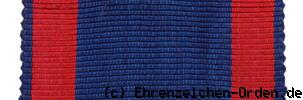
105 mm wide with 7 mm wide red sidebar and 2 mm edge
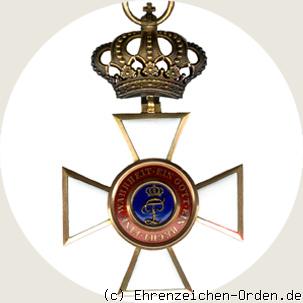 Front: Oldenburg House and Order of Merit Grand Cross with Gold Crown
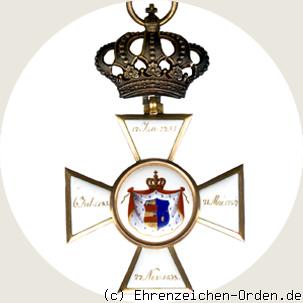 Reverse: Oldenburg House and Order of Merit Grand Cross with Gold Crown
Established:
November 27, 1838 by the Grand Duke Paul Friedrich Augustus
Data:
- Material: gold, enamel
- Size: 57mm x 94mm, crown 31 x 35mm
- Weight: about 46g
estimated collector price:
3500 - 3800 € in gold (early crosses more details)
2000 - 2200 € silver-gilded

 Awards of World War II