Awards of Germany - Order of Military Merit Cross 1. Class with swords
The Order of Military Merit of the 1st class was established on November 24, 1905 by Prince Regent Luitpold. He reorganized and expanded the order. The orders awarded before this continued to be worn according to new statutes and names. New Cross 1. The class was assigned with and without swords and ranked up to 2nd. After the Grand Cross. Swords, as shown here, were awarded for military merit. The corresponding thoracic star belonged to the 1st class. The 8-rayed star has a laid order cross with a flame between the cross arms and is smaller than that of the Grand Cross. (Grand cross about 95mm, 1st class about 70mm)
Classes after reorganization were Grand Cross, 1st Class with Star, 2nd Class with Star, 2nd Class, Officer's Cross, 3rd Class, 4th Class with Crown, and 4th Class. the cross of military merit was divided into 1st and 2nd classes. from 1918 the first 3 classes could also be awarded a crown.
The Order of Military Merit was established by King Ludwig II. It was created for brave military exploits, which were not enough to be awarded the Order of Max Joseph, but which, nevertheless, should have been appreciated. Initially, the award consisted of 5 classes: Grand Cross, Comtour, Knight 1st Class, Knight 2nd Class and Cavalier Cross for military merit. On February 26, 1900, an officer's cross was added to the order.
Crosses of the 1st class until 1916 were made of gold, after which they were gilded with silver. Other materials for manufacture were criminalized. Notable manufacturers were the Hemmerle brothers, Munich and Jakob Leser, Straubing. The order was subject to return. Heirs could, in exceptional cases, at will, acquire a distinction. In 1921, the Army Settlement Bureau compiled a list of amounts payable.
Eight-pointed cross made of gilded silver. Cross sleeves with golden edges are dark blue, translucently enameled. Including a herringbone-shaped band. Front and back with a gold middle shield. They are 3 partially made. Between the cross sleeves is a golden flame. Between the tips of the upper cruciform shoulder is an ornamented agraph with a parallel ear. A corrugated elongated bearing ring passes through the eye. 2 crossed golden Roman swords. On the reverse side of the agraph on the left is a silver mark -950-, and on the right - J L - for Jacob Leser, Straubing.
Front side:
- Round medallion, central black enameled gold, rough - L - under the Bavarian royal crown.
- This is surrounded by a wide white enameled belt hoop at the bottom with a buckle.
- It has a curved gold font at the top: - MERENTI - at the bottom of the antennae and points (belt holes).
Downside:
In - the black enameled middle part of the medallion is a golden Bavarian lion walking to the left.
- This is surrounded by a wide white enameled belt hoop at the bottom with a buckle.
- On it in the upper part there is a golden number: - 1866 - in the lower part of the antennae and points (belt holes).
Tape:
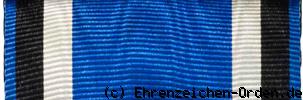
Tape 1 Military: flap 100 mm, edging blue 4 mm, side stripes black and white 9 mm each, central stripes blue 53 mm.
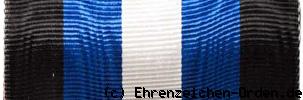
Volume 2 Civil: 100 mm sash, 20 mm stripes black/blue/white/blue/black.
Photos of military antiques Kögl www.mkoegl.de
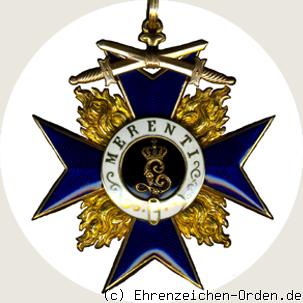 Obverse: Military Order of Merit Cross 1. Class with swords
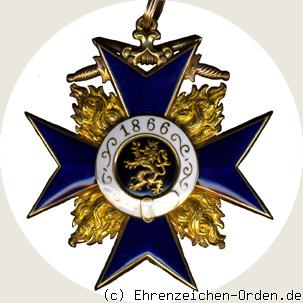 Reverse: Military Order of Merit Cross 1. Class with swords
Established:
July 19, 1866 by King Ludwig II.
November 24, 1905 1st Class Foundation
Data:
- Material: silver, gold, enamel
- Size: 66mm x 79.5mm, swords 39mm x 3mm
- Weight: about 57g
estimated collector price:
11000 - 12000 € in gold
9000 - 10000 € silver gilded

 Awards of World War II