Awards of Germany - Order of St. John from the hospital in Jerusalem
The cross depicted here, also called the professorial cross, was worn by members of the order on their uniforms or on civilian clothing to show membership in the order. Professorial crosses are silver without enamel and in the form of white enameled crosses like this one. In addition, smaller crosses were made (the so-called prince sizes). Crosses were purchased privately by members. Therefore, there are a wide variety of production and design options, especially for silver crosses.
The Royal Prussian Order of St. John was established by King Frederick William III. Founded in 1812. At the same time, he dissolved the Ballay Brandenburg and confiscated their possessions. Frederick William IV. October 15, 1852 resumed and restored the "Balley Brandenburg." Since then, the order has been called the knightly order of St. John of Jerusalem. Initially, the order consisted of 2 classes, grandmasters and knights of the order. With the renewal of 1852, the order consisted of the following classes: Protector's Cross, Master's Cross, Commander's Cross, Cavalier's Cross, Honor Cavaliers Cross and Honorary Members Cross. Real members of the order, komturas and legal knights, had to pay an annual fee of 12 thalers, as well as pay an entrance fee of 100 thalers. Knights of the Royal Prussian Order of St. John could become real knights of the order without an entrance fee. If they did not use it, they became honorary knights of the order. The king reserves the right to appoint new honorary knights, who had to pay 100 thalers for insignia. Persons who applied for an honorary knight had to pay 200 thalers. In 1853, Prince Karl of Prussia was elected Knight of the Order. Since 1883, after his death, Prince Friedrich Wilhelm Nikolaus Albrecht of Prussia accepted this dignity.
Silver eight-pointed cross with white enameled cross sleeves, silver burgundy. The reverse is smooth silver with a vertical pin with a mating hook. The center is enlarged and reinforced.
.
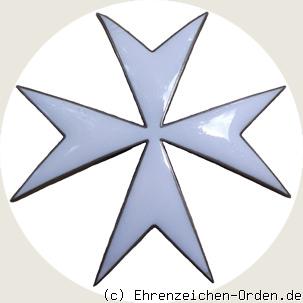 Front: Knightly Order of St. John from a hospital in Jerusalem
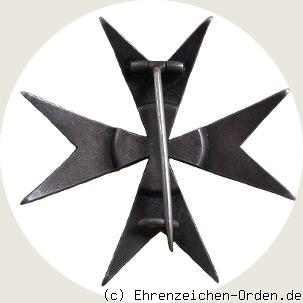 Reverse: Knightly Order of St. John from the hospital in Jerusalem
Established:
October 15, 1852 by King Frederick William IV.
Data:
- Material: silver/enamel
- Size: 48.5mm
- Weight: 15.8g
estimated collector price:
150 – 170 €

 Awards of World War II