Awards of Germany - Knightly Order of St. Hubert
The Order of St. Hubert was founded on November 3, 1444 by Duke Gerhard IV. established by Julich and Berg and is one of the first orders of Germany. The motto of the order was "IN TRAV VAST" in fidelity. The reason was the victory over Count Arnold of Egmont, who in 1444 invaded Julich several times, since he was not taken into account when awarding flax. Duke Gerhard IV. believed that he won only with the help of God and St. Hubert. After that, he established the order. The first charter was adopted on March 26, 1445. A prerequisite was, among other things, a four-part test of ancestors for chivalry and an oath of allegiance. The number of members was limited to 60. Until 1569, the order existed under various dukes. After that, the order died out. It was not until 1708 that it was restored. Elector Johann Wilhelm of the Palatinate, Duke of Jülich on June 27, 1708 became Erztruchses and received the Upper Palatinate and the County of Cham. The reunification of the lands served as an occasion on September 29, 1708 to revive the Order of St. Hubert. The number of princely knights was unlimited, the count and baron chapters were limited to 12. After some changes, the statutes were March 30,1800 by Elector Maximilian IV. Joseph took the final form. In 1808, the Order of the Knight of the House was approved by Saint Hubert as the first order of the Kingdom of Bavaria, which existed since 1806. During this period, a crown was added to the order cross. The Order of St. Hubert, if the chapters are also holders of the Grand Cross of the Order of Merit of the Bavarian Crown, stands in front of this order. In addition to 12 chapters, the order became sovereign and ruling princes and their male descendants and relatives. In addition, foreigners in the framework of the "exchange of orders" and persons whom the king considers especially worthy. 12 knights received from 1000 to 350 Reichsmarks. Of this, the knights had to give 1/10 to the poor. Gradually, payments stopped. When adopting the order, the principle of exclusivity was applied. That is, all other orders had to be folded. After death, he was to be returned within 3 months. For inclusion in the order, the princes were entitled to 200 gold ducats, count and baron knights - 100 gold ducats and an additional 100 Reichsmarks for a diploma. In 1858, the diploma was canceled. The Grand Master has always been king. Could not find (request) order. The order cross with a crown shown here is intended for bandaging. Order crosses for collans do not have a crown.
The award list through 1892 lists 907 awards. However, due to the strict duty of return and reallocation, only a portion must be received or available.
An eight-pointed cross made of gold with small balls on the tops. The cross levers are sheathed in gold and the inner ones in white enamel. Between the cross sleeves there are 3 gold strong, gold rays. On the front side is a large round medallion. The back is central with a large curved coat of arms. Between the balls of the upper cruciform shoulder is a soldered 5-tuberous, open, golden crown. A ring passes through the imperial apple of the crown.
Front side:
- On white enameled cross-shaped sleeves, 11 gold sparks are evenly distributed.
- Central shield with a wide smooth gold border. Inside is a wide ring.
- On the red, translucent enameled soil with pile, the old font rises:
- - IN - TRAV - VAST - (fidelity firmly) letters decorated
diamonds. In - locked midfield round gold medallion with green enameled background.
- It has a golden, plastic image of the legend of the conversion of St. Hubert.
- On the left, a deer with a (Hubertus) cross on its head in the middle is a knight with a squire, and on the right is a horse
.
Downside:
- On white enameled cross-shaped sleeves, 14 gold sparks are evenly distributed.
In the - center is a large curved shield. The rim is white enameled tape.
- The cover is made of gold. On it in black (in writing):
- - B - Memoriam - Recuperate - Dignitatis - Avitae - between the ends of the tape below - 1708 -.
- (In memory of the new-found dignity of 1708)
- A closed, curved field in the shape of a shield is enameled with red translucent paint.
- Including dressing. In the center is a golden imperial apple.
Tape:
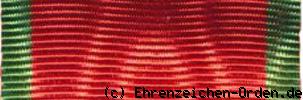
The 98 mm sash is red with 4 mm green side stripes.
The photos were taken with the support of Nagel auction house, Stuttgart .
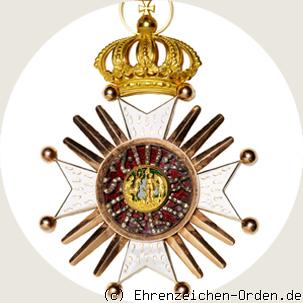 Obverse: Knight Order of Saint Hubert
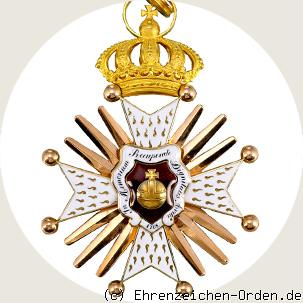 Reverse: Order of Chivalry of Saint Hubert
Established:
November 3, 1444 by Duke Gerhard IV. Julich and Berg
Awarded:
1812-1918 (with crown)
Data:
- Material: gold, enamel, diamonds
- Size: 116.5mm x 86mm, crown 36mm x 34mm
- Weight: about 105g
estimated collector price:
Unspecified

 Awards of World War II