German Awards - Gold Medal "For Military Merit" King Max Joseph I
The medal, originally presented by Elector Karl Theodor on October 30, 1794, is awarded in 2 classes, as a gold and silver medal for military merit. The award was based on a personal, bold act in the war. Medal winners received a monetary allowance. As of 1892, this amounted to 10 marks for a gold and 5 marks for a silver medal per month. When awarded the gold medal to the winners of the silver medal "For Military Merit," it was to be returned.
The first medals were awarded from 1794 to 1797 with the image of Karl Theodor. The second award period shows Max Joseph as Elector Max Joseph IV. granted from 1799 to 1806. The first medals with Max Joseph I as king began to be awarded since 1806. The stamp was carved by Joseph Losch, who worked at the Munich Mint from 1803 to 1826. Between 1806 and 1918, there were 2 different types of medals awarded, with a small and large chest portrait of the king. From 1806 to 1871 they were awarded medals with a reduced image of the chest of King Max Joseph I. They existed with and without the designation of a stamp cutter - Losch. The type depicted here comes from the coin medalist Johann Ries, who created new stamps in 1872. During World War I, this last medal was awarded. Awards of this type for 1901 are also accepted in China. In World War I, about 1000 gold medals were awarded. Since 1917, gold medals "For Military Merit" began to be made of silver with gilding. On the rim they have a silver seal of 1000 and a crescent. The eyelets of these medals were also teardrop-shaped, as were silver medals. By royal decree, the Military Merit Medal was renamed the Medal of Courage on March 2, 1918.
Round medal made of gold or gold-plated silver with a border. Above is a soldered round rough ear.
Front side:
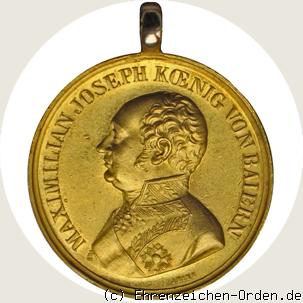
In the - center is a left-facing chest portrait of Max Joseph I in a general's uniform and cheek beard.
- Around the edge is the inscription: - MAXIMILIAN - JOSEPH - KING - VON - BAYER
- - Under the arm section small: - J.RIES -
Downside:
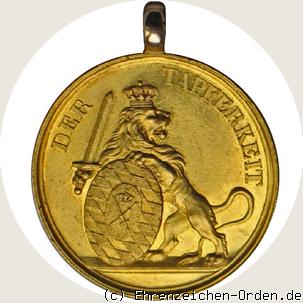
- On a pedestal standing upright, a crowned Bavarian lion, head to the right.
In the - left narthex he holds an oval royal coat of arms, on the right a sword up.
- Edge next to sword - DER - right edge next to lion - VALOR -
Tape:
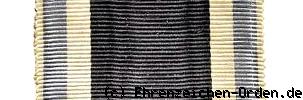
- 35 mm wide, white edges 1 mm, side stripes of light blue/white color 4 mm each, central stripes black 16 mm.
.
 Gold Medal "For Military Merit" King Max Joseph I
 Gold Medal "For Military Merit" King Max Joseph I
Established:
October 30, 1794 by Elector Karl Theodore (1777-1799)
Data:
- Material: Gold
- Size: 33.2mm
- Weight: 20.9g
estimated collector price:
4300 - 4500 € in gold
1500 - 1700 € silver gilded

 Awards of World War II