German Awards - Ludwig Gold Medal for Science and Art
The Ludwig Gold Medal for Science and Art was established on August 25, 1872 by King Ludwig II. donated by Bavaria. The Medal of Merit was awarded for commendable achievements in the field of science and art. For merits in industry, craft, agriculture and trade, another medal was simultaneously established. This is similar to the front end design. However, on the reverse side you can see a laurel wreath and a font - Merit. Both foreigners and foreigners were awarded. Rewarding women was especially allowed. The medal was limited to 6 awards per territory per year. However, it was possible to take it from. This award cannot be claimed. The king personally reserved the reward. Otherwise, ministerial requests were also considered. The Ludwig Medal was awarded with a diploma or diploma issued by the Ministry of State of the Royal House and Foreign Affairs. The names of the dead were published in a government bulletin. The medal was subject to return after death, which further increases the rarity today. The reverse of the medal was created by Carl Friedrich Voigt. Since 1829 he was a medalist of the Bavarian Mint. Prior to that, he worked in Berlin. The front side is made by J. Rhys, a stampelschneider in Darmstadt. The medal was awarded until 1918 417 times.
On July 13, 1914, King Ludwig III. The Ludwig Silver Medal was established for both areas. Due to the short award period, until 1918, these medals with the same design are even less common.
Round gold medal with raised edges. On the top of the medal is a wide, ornamented, floral agraff. A ribbon ring passes through Agraffe from above.
Front side:
- Large portrait of Ludwig II, facing right.
- On the left along the edge is the inscription - LUDWIG - II -. Right on the edge - KOENIG - V. - BAVARIA -.
- Under the neck, a small area along the edge of the punch cutters - J. RIES -.
Downside:
In the - center is a genius floating to the right, a female figure with billowing dresses and wings.
In her - right hand she holds a palm branch, in her left - a laurel wreath with ribbons.
- On the bottom right, under the swinging part of the clothes along the edge, the medal - VOIGT -.
Tape:
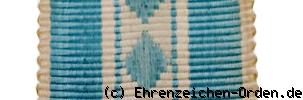
white 35 mm, white edges 2 mm, side stripes light blue 9 mm, central stripes between 2 light blue lines 1 mm high-edge light blue diamonds 6 mm
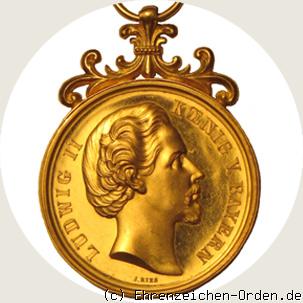 Front: Ludwig Gold Medal for Science and Art
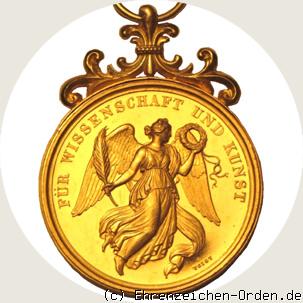 Downside: Ludwig Gold Medal for Science and Art
Established:
August 25, 1872 by King Ludwig II.
Data:
- Material: Gold
- Size: 35mm x 47mm, Agrafe 12 x 29mm
- Weight: 33.8g
estimated collector price:
3700 – 3800 €

 Awards of World War II