German Awards - Golden Women's Cross for Merit 1. Form
The silver brooch "For Merit to Women" was awarded as an honorary badge on April 25, 1892 by the Kaiser and King William II. at the insistence of his wife, he donated to Empress Augusta Victoria or approved her introduction. Crosses were awarded to women and maidens who have excelled and earned themselves through selfless charity work. In February 1900, the Badge of Honor was renamed the Silver Women's Cross for Merit. Initially, the one-class award was expanded from 1902 with the Golden Cross for Services to Women. This award now had 2 classes. The 1st class was a cross made of gilded silver and could be awarded a silver cross only after 10 years of possession of the 2nd class. Then it had to be turned in and returned. On October 22, 1907, the women's cross "For Merit" was accepted into the system of Prussian orders and approved as an order. The first lending period is indicated from 1893 to October 1907. During this period, silver brooches were awarded for merit without a ribbon, silver brooches for merit (women's crosses for merit since 1900) with a ribbon, and since 1902 - gold women's crosses for merit on a ribbon. Crosses with a ribbon had an ironing mechanism above the horizontal needle to place the ribbon decoration. Thus, the Golden Cross depicted here can be attributed to the first period. The gold degree was awarded only after consultation with the emperor. Silver crosses were granted by the office of the empress. The second award period is counted from 1908 (after recognition as an order) until November 1916. A distinctive feature of the 1st form is the absence of a horizontal pin and the changed technique of tape decoration (there is no ironing mechanism). In addition, only crosses with the royal crown were awarded to the rods, and not to Prussian women. Crosses were made in several pieces during the first two award periods. In the last period of 1917-1918, crosses were minted whole and had a simple oval eye as a ribbon reception.
The Women's Golden Cross of Merit is one of the rarest awards. In the first award period, only 5 crosses with the royal crown and 2 with the imperial crown (for non-Russians) were awarded. In the next two seasons, 18 and 7 awards were added, respectively.
Silver gilded, openwork work cross in the shape of a medallion. On top is attached the royal crown (queen's crown). At the back is a horizontal pin with mating hooks. Above the icon on the right is an ironing structure that serves to place the decoration of the ribbon under the crown. The elongated band ring is suspended from a long bridge with a small eye. On the tape in the center, on the oblong ring of the tape, there is a pin for turning.
Front side:
- The medallion is formed from a wide ring with a pearl chain along the outer edge.
- The inside is beveled. Between the line outside and inside is a blue enameled font:
- Top half: - FOR - ° - MERIT - centered on the ring on either side of an 8-band leaf star.
- Lower half: blue enameled laurel branches left and right.
- Below is the letter code - A - V - of the empress, decorated and enameled with blue paint.
In - a surrounded field, pierced by work, a cross with 3-fold figured and pointed ends.
- The bordered crosses are cross-hatched transversely and separated centrally by a diagonal cross.
- Inflorescences stylized in the corners of the sacrum. The tips of the cross and flowers touch the edge.
Downside:
- Smooth gilded rim with 2 ridges for fastening the crown.
- A cross of flowers lies under a hatched cross.
- On the right above the horizontal pin is an ironing mechanism.
Tape:
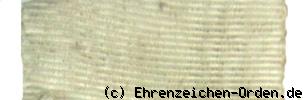
30 mm wide, for female grinding 15 mm wide
.
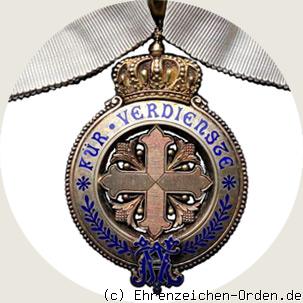 Obverse: Women's Merit Cross Gold 1. Form
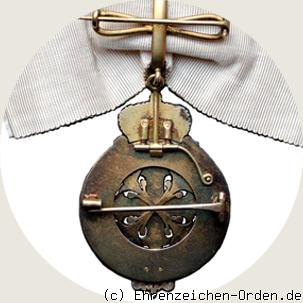 Reverse: Women's Golden Cross of Merit 1. Form
Established:
October 22, 1907 by the king and emperor William II.
Data:
- Material: silver gilded, partially enamelled
- Size: 57mm x 38mm
- Weight: about 32g
estimated collector price:
Unspecified

 Awards of World War II