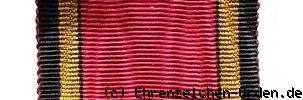
German Awards - Campaign Medal for 1813
The medals were presented by Princess Emma to Prince George Victor's guardian on 14 January 1850. Only officers, military officials and soldiers who stood on the battlefield and fought in front of the enemy (France) or were in direct contact were to be awarded. In addition, persons had to behave flawlessly and not be punished for war and other crimes. Medals were made of bronze. Delivery took place using a certificate. On September 24, 1850, in addition to the statutes, the engraving of annual numbers was approved. Various medals are known. There are medals with numbers 1813, 1813/1814, 1813/1815, 1814, 1814/1815, 1815, 1813/1814/1815, 1810 and without a year number. For engraving, it was necessary to prove participation in years. Medals without engraving were not engraved by the wearer. The ribbons exist in different color sequences because the national colors changed from red-gold-black to red-black-gold in 1814. The award number of all possible medals is 369 pieces. Medals divided into all kinds of engravings are extremely rare. Medals with the date 1810 are the least common, as very few Waldeckers returned from the campaign in Spain. The medals, dated 1810, 1813 and 1814, are of particular interest because Waldeck was still fighting for France and Napoleon at the time. Despite the goal outlined at Fonda, the fight against France, medals with the year numbers when Waldeck was still fighting for France were tolerated because the soldiers went to the field for Waldeck. Source: J. Nimmergut, Deutsche Orden und Ehrenzeichen bis 1945, vol. III, 1999.
Bronze medal with raised border. Above is a regular eye with a ribbon ring.
Front side:
- At a short distance from the edge, a laurel wreath is crucially connected from below.
In - the surrounded field in the crack of the letter - G. - V. -.
- Initials of Prince George Victor.
Downside:
- At a short distance from the edge, a wreath of oak leaves open from above is crossed from below.
In - a surrounded field in the center is a vertically standing ancient sword.
- The number of the year is engraved next to the blade of the sword: on the left - 18 -, on the right - 13 -.
Tape:
- Width 35 mm, side stripes black/gold 3 mm each, central stripes separated by thin black stripes of red 21 mm.
.
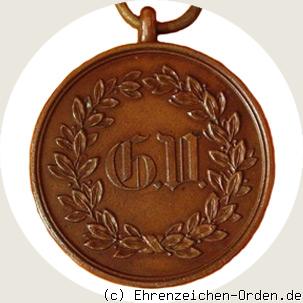 Obverse: Campaign Medal for 1813
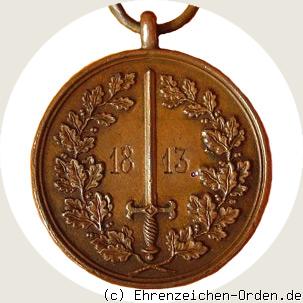 Reverse: Campaign Medal for 1813
Established:
January 14, 1850 by Princess Emma in the name of Prince George Victor
Data:
- Material: Bronze
- Size: 30mm
- Weight: 17.5g
estimated collector price:
1400 – 1500 €

 Awards of World War II