Germany Awards - Storm Düppeler Cross
The Duppel Assault Cross was established by King William I on October 18, 1864. It was created in 2 forms. The 1st white bronze uniform was intended for fighters in battle. Sanitary personnel, clergymen and other non-combatants received a cross on another ribbon. On April 18, 1865, the circle of persons eligible for admission was expanded to reserve troops and Ioannite knights with subordinate doctors, chaplains and orderlies. The 2nd form of blackened iron with a parallel ear was among the Johannites. These crosses are extremely rare, but often forged. The stamp to the cross was made by F.V. Kullrich, medalist of the Berlin Mint. On the main Berlin coin, 34,814 crosses of white bronze were minted. Award specimens are crosses with a furrowed, wider ear. Crosses with a simple wire lug are secondary parts or buckle parts.
In 1864, in the 2nd German-Danish war, Prussian troops defeated Denmark at the Duppel springboards of a fortified position at Sonderburg. This battle was decisive. The German-Danish War began with the Allied Prussian and Austrian invasion of Holstein on Christmas Day 1863. Prussia and Austria presented Denmark with an ultimatum to abolish the new Danish constitution of 16.01.1864, which Denmark rejected.
After the victory of Prussia and Austria 30.10.1864 the Vienna Peace ended this war. Denmark had to cede the duchies of Schleswig (Austria) and Holstein (Prussia), as well as Lauenburg.
White bronze cross. Cruciform shoulders with increased inward graduated edges. Between the cross sleeves is a laurel wreath. Front and back with embossed round central screen. On the upper cruciform shoulder is a soldered, grooved ear with a ribbon ring.
Front side:
- Round central shield with raised edge. In the center is a portrait of the head of William I, facing left.
- Along the edge is the inscription (4/5 above) - WILHELM KOENIG PRUSSIAN -.
Downside:
- Round central shield with raised edge.
In the - center is a Prussian eagle with outstretched wings on a cannon tube.
- On the cross sleeves there is an inscription: at the top -DUPPEL -, on the left - 18 -, on the right - APR. -, below - 1864
-.
Tape:
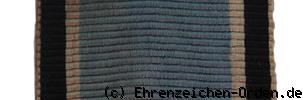
- Ribbon 1 fighter: 33 mm, white edging 1 mm, side stripes black and white, central stripes blue 17 mm.
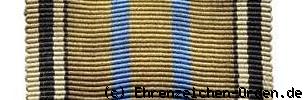
- Tape 2 Non-combat: 32 mm, side stripes white/black/white 5 mm, subsequently yellow 6 mm, 2 blue stripes 2 mm each, central yellow 6 mm.
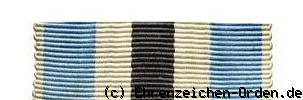
- Volume 3 Reserve troops: 32 mm, white edges 1 mm, edge stripes blue 8 mm, subsequently white 4 mm, medium black 4 mm.
.
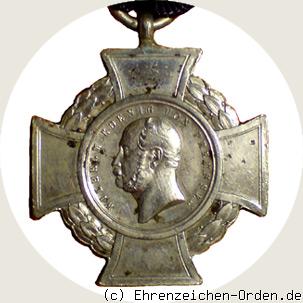 Face: Düppeler-Stormkreuz
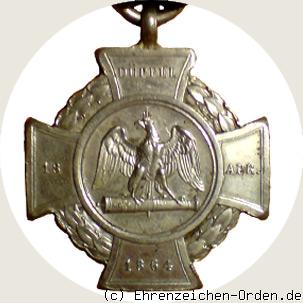 Reverse: Düppeler-Stormkreuz
Established:
October 18, 1864 by King William I.
Data:
- Material: white bronze
- Dimensions: 34.4 - 34.6 mm
- Weight: about 12.5g
estimated collector price:
60 - 80 € on fighter tape
80 - 90 € on non-belligerent strip
80 - 90 € in reserve group
OEK Number:
1928, 1929, 1930

 Awards of World War II