German Awards - Alsen Cross
The Alsen Cross was established on December 7, 1864 by King William I in 2 forms. The first light bronze uniform was intended for persons of the "fencing class," that is, officers and soldiers who took part in the battles. The second form of blackened iron was intended for doctors, chaplains and other non-combatant participants. On April 18, 1865, King William I expanded the circle of persons eligible for admission to reserve troops. They received a cross for the fighters on the modified tape. The stamp for the cross, as well as for the Düppel cross, was carved by F.V. Kullrich, the court medalist on the main Berlin coin. Award specimens are considered crosses with a wider, furrowed ear. Pieces with thin wire ears are considered second or chip. Blackened iron crosses are extremely rare, but often forged.
After the battle for the Düppel trenches and the victory of Prussia, negotiations on the division of Schleswig failed. On June 29, 1864, Prussians under the command of Hervart von Bittenfeld crossed the Alsensund to Alsen and captured the Alsen Peninsula. The plan came from Commander-in-Chief Leonard Count von Blumenthal. At night, about 2,500 Prussian soldiers crossed the Alsensund River. Alsen was defended by about 9,000 Danish soldiers, who suffered heavy losses (about 3,000 killed, wounded, prisoners). After the Battle of Alsen, the war against Denmark was decided.
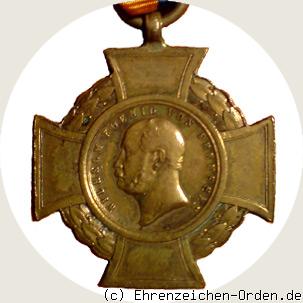
Light bronze cross. Cruciform shoulders with raised, graduated inward edges. Between the cross sleeves is a laurel wreath. On the upper cruciform shoulder is a soldered, grooved ear with a ribbon ring.
Front side:
- Round central shield with raised edge. In the center is a portrait of the head of William I, facing left.
- On the edge rewritten (upper 4/5) - WILHELM KOENIG PRUSSIAN -.
Downside:
- Round central shield with raised edge. It has a Prussian eagle flying to the left.
- He holds a wreath of victory in his paws. Including a small landing boat.
With - on the right side of the boat is a flag that flies against the direction of travel.
- On the cross sleeves there is an inscription: at the top -ALSEN -, on the left - 29 -, on the right - JUNE. -, below - 1864 -.
Tape:
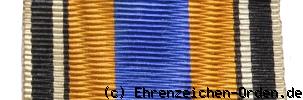
- Fighter Belt 1: 32mm, white/black/white rim, then 5mm golden yellow stripe, 9mm central stripe blue
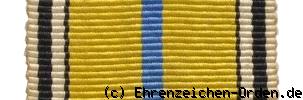
- Tape 2 for non-combat: 32 mm, white/black/white rim, then golden yellow stripes 10 mm, central stripes 2.5 mm blue
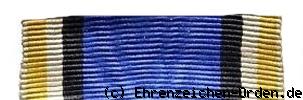
- Ribbon 3 for reserve troops: 32mm, white/yellow/white/black edge 6mm, central stripe 20mm blue
 Front side: Alsen cross
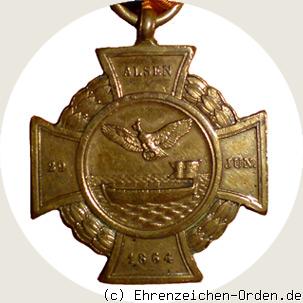 Reverse: Alsen Cross
Established:
December 7, 1864 by King William I.
Data:
- Material: bright bronze
- Dimensions: 31.8 - 31.9 mm
- Weight: about 12.5g
estimated collector price:
70 - €80 on fighter tape
100 - 110 € on non-belligerent strip
100 - 110 € in group reserve
OEK Number:
1932, 1933, 1934

 Awards of World War II