German Awards - 3rd Degree Service Award for 9 years of 1913
Awards for non-commissioned officers and soldiers in the Kingdom of Saxony were first established in 24. 12. 1831 by King Anton and his co-ruler Frederick Augustus. The first form consisted of a two-class for 15 years of service in silver and 10 years in bronze. The inscription on the back read - for a long and good service. This form was replaced by the foundation of official awards on April 23, 1874 by King Albert. Awards were now given to officers, a cross after 25 years of service, Landwehr in 2nd grade, and for non-commissioned officers and soldiers in 3rd grade, 21, 15 and 9 years of service. All 3 classes continued to have a medal form in gold, silver and bronze. The reverse side of Scripture was now - for long and faithful service -. This new form of awarding was established or introduced by King Frederick Augustus III in 1913. These service awards replaced the awards in force until then. 1st class was now a cross of gilded bronze. Second and third. The class (shown here) is still medals. The 3rd class was acquired for 9 years of unquestioning and faithful service as a soldier or non-commissioned officer of the standing army in Saxony. The war years, as before, were considered double. The new form of service distinction could be exchanged at their own expense. Service awards were subject to return after death, but could be redeemed by relatives of the victims.
A round medal with a border of argentan (also nickel silver) on top of a soldered eye with a ribbon ring.
Front side:
In the - center in each other are the letters - F - A - R - above them is a crown.
- The letters are surrounded by a wreath of left oak foliage, right laurel foliage, connected from below.
- Top Left Edge - Fidelity - Top Right Edge - Services - Bottom - Flag -
Downside:
In - center of the field Roman number 9 - IX - thicker strokes crosswise shaded.
Tape:
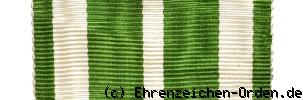
green 35 mm wide, edges 3 mm, side stripes white 4 mm, central stripes white 2 mm.
Photos courtesy of "Münzgalerie-Frankfurter Allee"
10247 Berlin, Frankfurter Allee 106a
Contacts: muenzgalerie.gietzelt@gmx.de
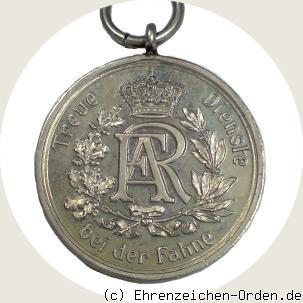 Front: 3rd class service award for 9 years of 1913
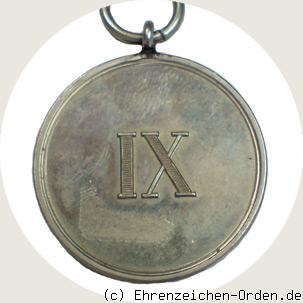 Reverse: 3rd class service award for 9 years of 1913
Established:
September 6, 1913 by King Frederick Augustus III.
Data:
- Material: Argentan (new silver)
- Size: 29.5mm
- Weight: 13.5g
estimated collector price:
30 – 40 €

 Awards of World War II