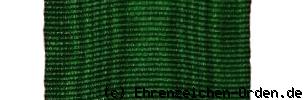
German Awards - Service Award 3. Class for 9 years 1914
Service awards of the last form were established by Duke Frederick II on January 1, 1914 in the 3rd grade.
1st class was a cross for 15 years, 2nd and 3rd. Class - medals for 12 and 9 years of service, respectively. The 1870 buckles, awarded by that time for 21, 15 and 9 years, were replaced by a new service award.
Old service awards could be exchanged for new ones at their own expense. Shortened terms counted. The award was presented to non-commissioned officers and crews of the Anhalta contingent, as well as the jaeger brigade (district police). The badges of honor were refundable, but could be purchased by relatives for reimbursement. Service awards were delivered by the court engraver Alexander Vollram from Dessau.
In Anhalt, service awards were first established in Anhalt-Bernburg by Duke Alexander Karl and in Anhalt-Köthen on October 29, 1847 by Duke Henry. They were awarded in the form of a buckle in 3 classes, for 21, 15 and 9 years of service. They wore - ALEX - CARL - respectively the Gothic letter - H - and the corresponding Roman number. In Anhalt-Dessau-Köthen, on February 1, 1848, service awards were established for 20 and 12 years of service. The 2nd form was created by Duke Leopold IV. introduced by Anhalt-Dessau-Köthen on April 17, 1855. While maintaining the positions, the buckles were now supplied with the Gothic letter - L. Soldiers were awarded, starting with sergeant major below the ducal federal contingent and gendarmerie. Years of war were counted twice, and years of service in another German state were counted. Duke Leopold IV. April 6, 1870 established for the entire land of Anhalt service awards in the form of a buckle for 21, 15 and 9 years of service. According to the military convention with Prussia in 1867, the regiment became the Ankhalta Infantry Regiment No. 93. Until 1870, only Anhaltiner could receive a service award. Prussian soldiers in the regiment were excluded. Buckles awarded since 1870 could be awarded without regard to nationality. Source: Gerd Scharfenberg, Order and Badge of Honor of the Anhalt States, 1999 .
Round medal made of white metal or argentan with a raised border. Above is a soldered ordinary eye with a ribbon ring.
Front side:
In the - center is a large Gothic letter - F -, above it is a 5-arc half-double crown.
- At the top is a curved font at the break - loyalty - services -.
- Below is a curved font at a fracture - at - flag -.
Downside:
In the - center, on a smooth background, the Roman number 9, - IX, - which is shaded with perpendicular strokes in the transverse direction.
Tape:
.
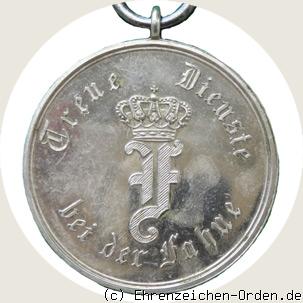 Front: Service Award 3. Class for 9 years 1914
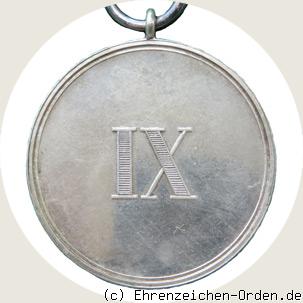 Downside: Service Award 3. Class for 9 years 1914
Established:
January 1, 1914 by Duke Frederick II.
Data:
- Material: Argentan
- Size: 30mm
- Weight: 13.4g
estimated collector price:
70 – 90 €

 Awards of World War II