German Awards - Service Award 1. Class for 15 years
New service awards for non-commissioned officers were established on June 6, 1914 by Prince Gunther von Schwarzburg Rudolstadt and Sondershausen. With partial changes in the ordinances of December 17, 1869 in Rudolstadt and April 1, 1870 in Sondershausen, service awards were established for both principalities.
In Rudolstadt, for the first time in 1850, service awards were established for officers and non-commissioned officers in the form of a cross and a medal, which were awarded before the military convention of 1867 with Prussia. After that, service awards were presented in the form of a buckle for non-commissioned officers of the 7th Thuringian Infantry Regiment No. 96 and gendarmes.
Already in 1838, service awards were established in Sondershausen for officers, non-commissioned officers and gendarmes in the form of a cross and a buckle. Since 1867, the contingent began to be in the 3rd Thuringian Infantry Regiment No. 71, and buckles were issued only to gendarmes.
The award of service awards in the form of a buckle ended in both principalities with the establishment of common service awards for non-commissioned officers in the 3rd grade. 1st class was a cross and was awarded after 15 years of service. Second and third. The class was awarded as a medal after 12 and 9 years of service respectively. The awards received by then were to be replaced with a new uniform. Persons already dismissed from service could purchase and establish a bonus at their own expense.
Gilded bronze cross with straight cross sleeves. The transverse arms have a 3-fold line fit along the edge. The inner sides are slightly convex and smooth. The front and rear parts have a round, embossed central shield. On the upper cruciform shoulder is a soldered ordinary eye with a ribbon ring.
Front side:
- Central shield with 2 raised, smooth edges. The inner field is smooth.
In - the surrounded field, a decorated letter rises above it - G - a large princely hat.
Downside:
- Central shield with 2 raised, smooth edges. The inner field is smooth.
In a surrounded - field, the Roman number 15-XV -. Wide normals are cross-hatched.
Tape:
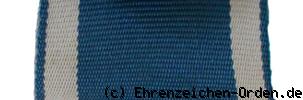
Blue width 30 mm, edges 1 mm, white side stripes 4 mm.
.
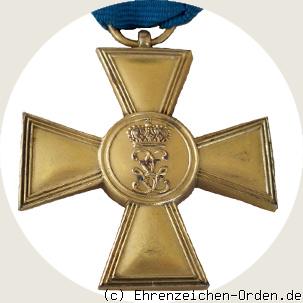 Front: Service Award 1. Class for 15 years
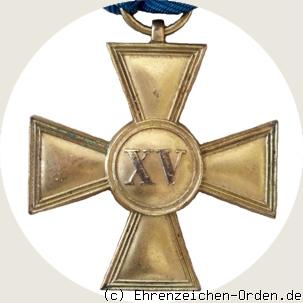 Downside: Service Award 1. Class for 15 years
Established:
June 6, 1914 Prince Gunther von Schwarzburg Rudolstadt and Sondershausen
Data:
- Material: Bronze gilded
- Size: 36mm
- Weight: 15, 4g
estimated collector price:
180 – 200 €

 Awards of World War II