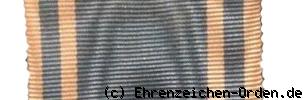
Awards of Germany - Insignia of the 1st degree for 15 years of 1913
Awards for service in the Bavarian army were first established by King Max I on January 13, 1816. The award was a veteran's shield and was awarded to non-commissioned officers and soldiers for 40 and 24 years of service in the Bavarian army. The service life by that time was indicated by white stripes (chevrons) on the upper sleeve of the uniform. Every 6 years it was joined by a strip. So, at the age of 18, the soldier had 3 stripes on his forearm. After that, signs of veterans on a red cloth were awarded. On March 03, 1865, King Ludwig II established new service awards (seniority marks) in cruciform form for 40 and 24 years, which were now also awarded to officers and military officials. On January 21, 1876, King Ludwig II. established new service awards in 3 classes for non-commissioned officers and soldiers in buckle uniforms. Service life was reduced to 21 years for 1st class, 15 years for 2nd class and 9 years for 3rd class. The service award shown here was instituted on 30 August 1913 by Prince Regent Luitpold. Now it consisted of a cross as 1. Class for 15 years and 2 medals for 12 and 9 years of service to 2nd and 3rd classes. The old service award in the form of a buckle could be exchanged. Source: J. Nimmergut, Deutsche Orden und Ehrenzeichen bis 1945, vol. 1, 1997.
Light tombac cross (copper here). Cruciform shoulders with raised smooth edge. The inner sides are cross-hatched. The ends of the crosspiece are slightly bent inward and beveled at the corners. Front and back with 19 mm embossed central screen. Above is a soldered ordinary eye with a ribbon ring.
Front side:
- Central shield with border. Inside is a figured shield with Bavarian rhombuses.
- The background is finely grainy.
Downside:
- Central shield with border. Inside is a figured, smooth shield.
In - it, the Roman number 15 - XV -.
- The background is finely grainy.
Tape:
- 35 mm wide, white edges 2 mm, side stripes of light blue/white color 2 mm/3 mm, central stripes of light blue color 20 mm.
.
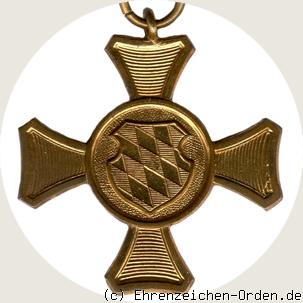 Front: 1st Class Service Award for 15 years 1913
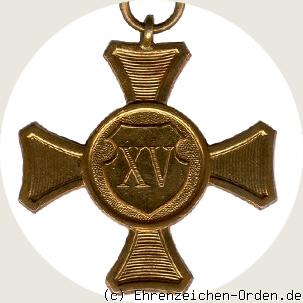 Reverse: 1st Class Service Award for 15 years 1913
Established:
August 30, 1913 Prince Regent Ludwig
Data:
- Material: Red yellow Tombak
- Size: 43mm x 44mm
- Weight: 10.4g
estimated collector price:
50 – 60 €

 Awards of World War II