German Awards - Common Badge of Honor For Conscientious Work in Silver
Grand Duke Wilhelm Ernst established the General Badge of Honor on June 25, 1902 in three classes: gold (silver gilded), silver and bronze. The Badge of Honor was awarded with 4 different backs. For the citizens of Weimar, medals were awarded - "For Merit," "For Faithful Service" and "For Faithful Work." Foreign citizens received a badge of honor with the code -WE - under the crown. The medal was awarded for outstanding services, primarily for many years and exemplary performance of official duties and conscientious work. Initiations were also possible "as a sign of Our favor." Separate classes were awarded depending on the position of the proposed. Generally, officials, employees and workers who have performed their duties for at least 30 years with the host may be offered. In retirement, this could be abandoned. The bronze medal was intended for lower-level employees such as domestic servants, domestic servants, and ordinary workers. Secondary ranks such as registrars, elders, school principals, etc. should be awarded a silver medal. The next higher class should be awarded when rewarding. The first award of the gold medal was to take place only for completely exceptional services. The medal shown here - For conscientious work - was intended for workers. The stamps of the medal were made by the sculptor and medalist from Berlin Arthur Kruger. Since 1895 he was the holder of the Berlin medal coin. Exact award figures are not known. Source: J. Nimmergut, Deutsche Orden und Ehrenzeichen bis 1945, vol. III, 1999.
Round silver medal with raised border. On top is a soldered, ordinary eye with a ribbon ring. Top right on the edge of the stigma - SILVER - 990 -.
Front side:
- On the margins is the inscription: - WILHELM - ERNST - GRAND DUKE - VON - SAXONY -.
In the - center is a portrait of the Grand Duke, facing left.
- Down the edge is a small manufacturer: - A. KRUGER F. -
Downside:
- Along the edge above is an open wreath of oak deciduous branches, tied with a loop below.
- The branches consist of 6 dense groups of leaves each.
- In the nested field, the 3-line enlarged font is FOR -/- TREUE -/- WORK -.
Tape:
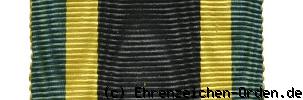
- Width 39 mm, side stripes green/yellow 5 mm each, central stripes black 19 mm.
.
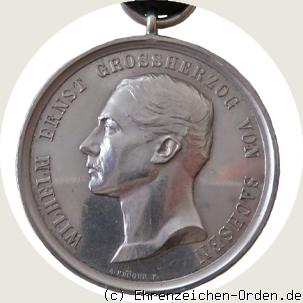 Obverse: Common Badge of Honor For Hard Work in Silver
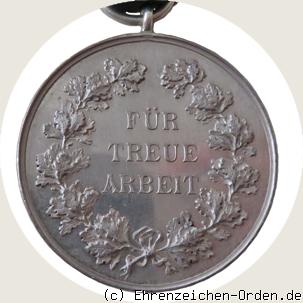 Reverse: Common Badge of Honor For Conscientious Work in Silver
Established:
June 25, 1902 Grand Duke Wilhelm Ernst
Data:
- Material: Silver
- Size: 36mm
- Weight: about 24g
estimated collector price:
260 – 280 €

 Awards of World War II