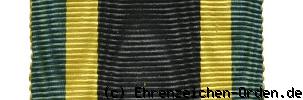
German Awards - Common Badge of Honor for Foreigners in Gold
The medal presented here was awarded to persons who were not subjects of the Grand Duchy. A common badge of honor for foreigners was also awarded in gold, silver and bronze. The reverse shows the crowned nominal schiffr - W E -. The general badge of honor was renewed on June 25, 1902 by the Grand Duke Wilhelm Ernst. The statutes of the previously awarded merit medals were abolished, and the medal was equipped with a stuffed grand duke. The medal was presented in 3 stages: gold (silver gilded), silver and bronze. The medal was awarded for outstanding services, many years of exemplary performance of official duties and conscientious work, as well as in favor of the ruling house. For his services in the war he was awarded the General Badge of Honor with a ribbon buckle with crossed swords attached to it. (19 mm x 44 mm) This color corresponds to the assigned step. Belt buckles with swords were awarded during the South West Africa campaign. In gold 3 pieces, silver 10 and bronze 17 Weimar soldiers were awarded. The stamps of the medal were made by Arthur Kruger, the owner of the Berlin medal coin. Citizens of Belarus received a medal with other backs. As a rule, he stood in an oak-leafy wreath - DEM - MERIT -. But medals with inscriptions were also issued - FOR - LOYALTY - SERVICE - and - FOR - LOYALTY - LABOR. Source: Lutz Fritsche, Order and Badge of Honor of the Grand Duchy of Saxe-Weimar-Eisenach 1815-1918, 2012.
Round medal of gilded silver with a raised border. Above is a soldered ordinary eye with a ribbon ring. In addition to the eye on the rim, the punch is SILVER - 0.990 -.
Front side:
- On the margins is the inscription: - WILHELM - ERNST - GRAND DUKE - VON - SAXONY -.
In the - center is a portrait of the Grand Duke, facing left.
- Down the edge is a small manufacturer: - A. KRUGER F. -
Downside:
In the - center, under the crown, the letters - W - E - are intertwined and decorated.
Tape:
- Width 39 mm, side stripes green/yellow 5 mm each, central stripes black 19 mm.
.
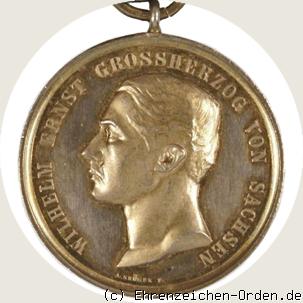 Obverse: Common badge of honour for foreigners in gold
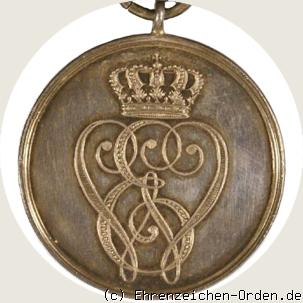 Downside: Common badge of honour for foreigners in gold
Established:
June 25, 1902 Grand Duke Wilhelm Ernst
Data:
- Material: Silver gilded
- Size: 35.9mm
- Weight: 21.3g
estimated collector price:
350 – 400 €

 Awards of World War II