Awards of Germany - Sign for the 100th anniversary of the hussar regiment No. 17
The badge was awarded on the occasion of the 100th anniversary of the Braunschweig Hussar Regiment No. 17. The right to receive was probably the former and still active members of the regiment who participated in the celebrations.
The formation of the regiment dates back to 1809. Friedrich Wilhelm of Braunschweig, called the Black Duke, from April 1, 1809 formed a volunteer corps of about 2,000 people, including 1,000 hussars, to fight Napoleon. The corps became known as the "Black Squad." First, under Austrian command, after the defeat at Wagram, the regiment fled to England, where he switched to English service. Under English command, he fought in Spain and Sicily from 1813 to 1815. The duke restored a new hussar regiment in 1814 at Braunschweig in Wolfenbüttel, while the original regiment remained in English service. This regiment participated in the battles of Quatre Bras and Waterloo. The designation Duke of Braunschweig Hussar Regiment No. 17 received in 1867. According to the military convention with Prussia, since 1886 it was called the Braunschweig Hussar Regiment No. 17.
The regiment also had the epithet "Hussars-skulls" due to the headdress wearing a dead head with carved bones and currency tape.
In the war of 1870/71, the regiment fought in many places of battles, such as Spicheren, Metz, Mars-la-Tour, Paris, etc.
In World War I, it was used only in the West, and in September 1914 it was divided between various units. After the war, a volunteer squadron of horsemen was created in 1919, which served in Bremen, Wilhelmshaven and Emden. He was later admitted to Reichswehr Reuter Regiment No. 13 Lüneburg. The 4th squadron of the regiment took over the traditional care of the Braunschweig hussars.
The sign is found with and without a ribbon loop. The manufacturer was Bremer, Markneukirchen.
Non-ferrous metal badges in the form of an 8-beam, silver-plated cross. In the center is a gilded enameled cross with a gilded ribbon under it. A ribbon loop with an enameled coat of arms worn is attached to the upper cross. The back is smooth and silvery with a horizontal pin in the center of the star.
Front side:
- A star with 8 longer main rays. There are 7 stepped intermediate jets between them.
- The laid cross is a golden border with small balls on the tops.
- The inner sides of the cruciform sleeves are enameled in blue. Central shield with gold border.
- On a red enameled substrate rises a silver bust of the "Black Duke."
- Friedrich Wilhelm of Brunswick, founder of the regiment.
- On the lower cruciform shoulder is a silver dead head with crossed bones under it.
- Under the lower cross sleeve is a gilded book ribbon with side laurel leaves.
- It has in-depth figures of the year - 1809 - - - 1909 -.
- Straps in blue and yellow. The laid, curved shield is red enameled.
- She has Saxenross jumping to the left on a pedestal.
Downside:
- Smooth and silver. A horizontal icon is soldered in the center with the plate.
- On it the manufacturer is G. BREMER -/- MARKNEUKIRCHEN -.
- Upper and lower 2 cotter pins, with which the overhead cross is attached.
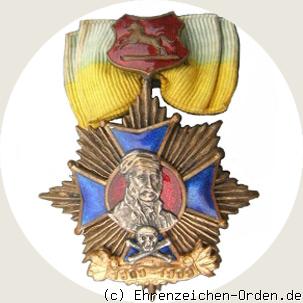 Obverse: Badge for 100th anniversary of No. 17 Hussar Regiment
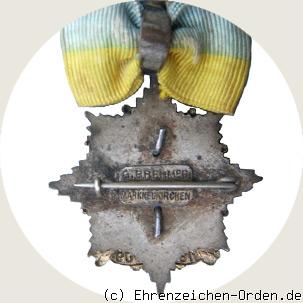 Reverse: badge for the 100th anniversary of Hussar Regiment No. 17
Established:
1909 - Unification of warriors. Members of the regiment
Data:
- Material: non-ferrous metal, silver plated, gold plated, enamel
- Size: 39.5mm x 41mm (Star)
- Weight: 18g
estimated collector price:
70 – 90 €

 Awards of World War II