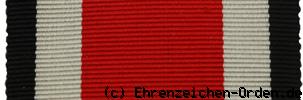
German Awards - Knight's Cross of the Iron Cross 1939
The Knight's Cross of the Iron Cross was established as an additional class of the Iron Cross on September 1, 1939 by Reich Chancellor Adolf Hitler. He took the place of the former Order of Pour le Merite. The Knight's Cross was the second highest military award in the 3rd Reich, the highest award was the Grand Cross of the Iron Cross, which was awarded only 1 time to Hermann Goering. Crusader knights enjoyed heroic status in the 3rd Reich and were glorified and used as models for young people for propaganda purposes.
During the awarding period, there was some expansion of the Knight's Cross. On June 3, 1940, Oak Leaves were presented to the Knight's Cross. On September 28, 1941, the Knight's Cross was expanded with Oak foliage with swords and Oak foliage with swords and diamonds. The last expansion took place on December 29, 1944. The knight's cross could now be awarded with gold oak leaves with swords and diamonds.
Awarding the Knight's Cross involved the possession of the Iron Cross of the 1st and 2nd class. The "iron crosses" of the First World War were not taken into account. Exceptionally, all 3 classes were awarded simultaneously. When re-awarded the Knight's Cross, only extensions were awarded. The knight's cross was worn with a ribbon around its neck.
The Knight's Cross was awarded 7313 times. Knight's cross with oak leaves 890 times. Knight's cross with oak leaves and swords 160 times. With oak leaves swords and diamonds, 27 awards are known. Made of gold 12 pieces and awarded only 1 time. After the assassination attempt on July 20, 1944, several knightly crosses were deprived during the show trial. Source: J. Nimmergut, Deutsche Orden und Ehrenzeichen bis 1945, vol. VI, 2001.
The cross consists of 2 parts of a silver edge, which are soldered. The cluster has a raised, located inside, 2-step edge, from which the inner edge is shaded semicircular and finely transverse. Between them is an inner cross of blackened iron. The inner crosses were also made of non-ferrous metal, they are unmarked. Above is a transversely standing eyelet with an elongated jump ring. On it are silver coins 800 and 65 for Klein and Quenzer. There are 800 silver marks on the back under the eye.
Crosses without manufacturers were also awarded.
Front side:
In the - center of the iron core is an oblique swastika.
In - the lower cross sleeve number of the year - 1939 -
Downside:
In - lower cross sleeve year - 1813 -
- Other wishbones and center are smooth.
Tape:
- Neck cross 48 mm wide, side stripes black/white 6 mm each, central stripes red 24 mm.
.
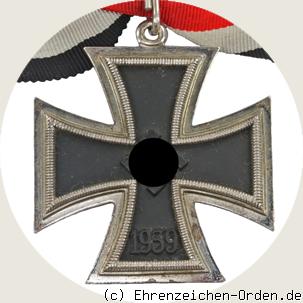 Obverse: Knight's Cross of the Iron Cross 1939
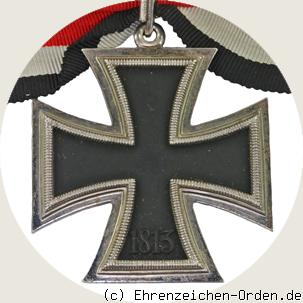 Reverse: Knight's Cross of the Iron Cross 1939
Established:
September 1, 1939 Adolf Hitler
Data:
- Material: silver, iron
- Size: 48.2 - 48mm without eye
- Weight: About 32.9g
estimated collector price:
6,700 - 8,000 € Manufacturer 65
OEK Number:
3821 – 3821/8

 Awards of World War II