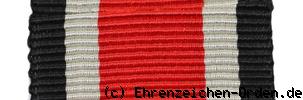
German Awards - Iron Cross 1939 2nd Class
Iron Cross 2. The class, in colloquial synkel form, was awarded only during the initial period of World War II. The shape of the gammon refers to the shape of the king, which is still executed in a narrow manner, like the iron crosses of World War I. This form is very popular with collectors, and because of the rarity, these crosses also reach a higher price.
The Iron Cross was restored on 1 September 1939 by Adolf Hitler as a military decoration and expanded to the level of Knight's Cross. The latter took the position of the Prussian Pour le Merite. Various promotions were introduced to the knight's cross in the course of the war, such as oak leaves, swords, oak leaves with swords, diamonds, and gilded oak leaves with swords and diamonds. Thus, the Iron Cross of 1939 now consisted of 4 classes: Grand Cross, Knight's Cross (with its promotions), 1st Class and 2nd Class. Unlike the originally Prussian award, the Iron Cross of 1939 was awarded on a different ribbon and awarded only to fighters. Source: J. Nimmergut, Deutsche Orden und Ehrenzeichen bis 1945, vol. VI, 2001.
The cross consists of a two-part silver (also silver-plated) rim, the latter soldered. The cluster has a raised, located inside, 2-step edge, from which the inner edge is shaded semicircular and finely transverse. Between them is an inner cross of blackened iron (magnetic) or blackened non-ferrous metal. On the upper cruciform shoulder is a soldered ordinary eye with a ribbon ring.
Front side:
In the - center of the iron core is an oblique swastika.
In - the lower cross sleeve number of the year - 1939 -
Downside:
In - lower cross sleeve year - 1813 -
- Other wishbones and center are smooth.
Tape:
- Width 30 mm, side stripes black/white 4 mm each, central stripes red 14 mm.
Photos of www.militaria-berlin.de
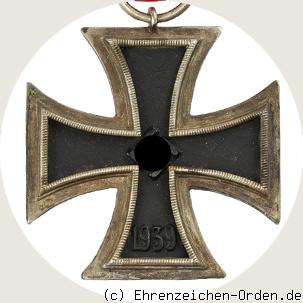 Front: Iron Cross 1939 2nd Class
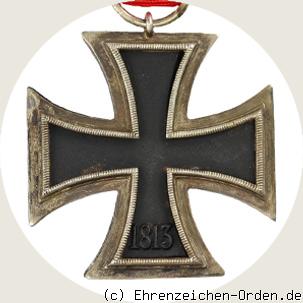 Reverse: Iron Cross 1939 2nd Class
Established:
September 1, 1939 Adolf Hitler
Data:
- Material: iron/silver or silver-plated
- Size: 42.5mm
- Weight: 15.6g
estimated collector price:
280 – 300 €

 Awards of World War II