Germany Awards - Close Combat Weapons in Silver
This award was established for infantry on November 25, 1942 by decree of Adolf Hitler. This was caused by the increasing brutality of the war and the need to maintain the will to fight. This award was the highest award given specifically to infantry. The foundation was made in 3 stages of bronze, silver and gold. The ordinance provided for a bronze screed for 15 days of hand-to-hand combat, a silver screed for 30 days of hand-to-hand combat and a gold screed for 50 days. For this, lists signed by the company commander were compiled. However, by the end of the war, this was hardly preserved. For the wounded who could no longer continue the fight, there were special rules: bronze 10, silver 20 and gold 40. In the case of fallen soldiers who met the requirements, the screed was awarded subsequently and sent to the relatives of the victims. On the other hand, soldiers who were captured or missing lost the right to screed. The number of awards is estimated at about 37,000 for bronze, 9500 for silver and 630 for gold. Due to the small number of awards, melee braces had a high reputation. Source: J. Nimmergut, Deutsche Orden und Ehrenzeichen before 1945, vol. IV, 2001.
Wide silver plated zinc clasp. Cover plate is made of iron. At the back is a horizontal pin. On the back with high embossing manufacturers.
Front side:
In - the center of the screed is a figured quadrangle with oak leaves from the bottom and side.
- Above is an army eagle with outstretched wings in its paws obliquely set swastika.
- A side rifle and a hand grenade are crossed and laid on the edge under it.
From - the sides to the left and right are oak leaves lying on striped quadrangles standing at the apex.
- From the middle shield 1 sheet with 2 acorns, at the ends 3 sheets
Downside:
- On the right in 3 circles - F - L - L - for Friedrich Linden, Ludenscheid.
- On the left, the 2-row is FEC. W. E. PEEKHAUS -/- BERLIN -.
Photos of www.militaria-berlin.de
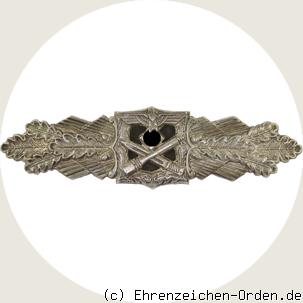 Front side: army edging in silver
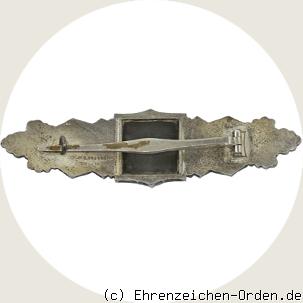 Reverse: Army edging in silver
Established:
November 25, 1942 Adolf Hitler
Data:
- Material: non-ferrous silver-plated metal
- Size: 26 x 97.8mm
- Weight: about 31g
estimated collector price:
550 - 600 € in silver-plated non-ferrous metal
440 - 450 € silver-plated in zinc

 Awards of World War II