German Awards - Infantry Assault Marks in Silver
The badge "Assault Infantry" was awarded on December 20, 1939 by Walter von Brauchitsch to the Commander-in-Chief of the Ground Forces. This was to be visible evidence and recognition for the infantrymen who showed themselves in the assault. In addition, the badge was supposed to serve as an incentive for the rest of the troops. The badge was awarded to officers, non-commissioned officers and soldiers who served in rifle companies, non-motorized infantry divisions and mountain jaeger companies. The condition for the award was that from January 1, 1940, the soldier participated in 3 assault attacks, fought on the front line, attempted hacking with weapons, or participated in hostilities on 3 different days. The badge was presented with a certificate of possession. Units of machine gun companies, artillery companies and anti-tank companies received a bronze badge with an equal provision for awarding. Later, the circle of persons eligible for this was expanded to SS troops and order police. The badge design was developed by the Berlin company Juncker. The first badges were silver plated in Tombac. However, most badges are silver plated from fine zinc. Hollow embossed badges were issued, as well as solid cast badges. Many different manufacturers are known. The manufacturer's label is usually on the back. Often even infantry assault marks were issued unmarked by the manufacturer. Exact award figures are not known. Estimates suggest about 500,000. Source: J. Nimmergut, Deutsche Orden und Ehrenzeichen before 1945, vol. IV, 2001.
High oval, openwork, fully embossed badge of silver-plated zinc. At the back is a vertical pin.
Front side:
- The edge is formed from an oak deciduous wreath with acorns tied below.
- Above is the emblem of the army (an eagle with lowered wings in the paws of a swastika).
- A carbine tilted to the left up with a side gun on.
- The carbine protrudes and is superimposed on the edge above and below.
Downside:
- Smooth and silver plated with perpendicular pin and reciprocal hook.
- Top producer - CW -.
Photos of www.militaria-berlin.de
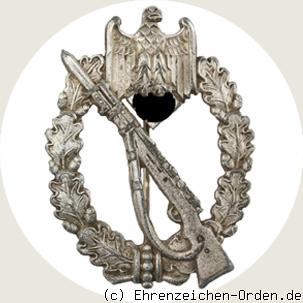 Front side: infantry badge in silver
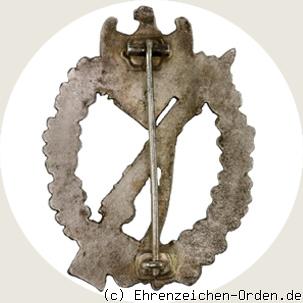 Reverse: Infantry badge in silver
Established:
December 20, 1939 Walter von Brauchitsch
Data:
- Material: silver-plated zinc
- Size: 47 x 61mm
- Weight: about 32g
estimated collector price:
150 - 180 € silver plated in Tombac
80 - 100 € in silver-plated zinc

 Awards of World War II