Germany Awards - Gold Car Verification Badge
The sign was established by decree of Adolf Hitler on October 3, 23 in 1942 degrees - bronze, silver and gold. The sign was intended to recognize drivers who have been tested in military affairs. The prerequisite was driving in difficult conditions or special merits in the preservation and care of entrusted vehicles. To get a higher level, it was necessary to fulfill the conditions again. The operation began on December 1, 1940 in certain areas. These included the countries of Southern and Southeastern Europe, located north of the Arctic Circle, territories from the Russian border, Lapland and Africa. During the war years, territories such as Italy, Estonia, Latvia and Lithuania were added. In the end, all areas of the retreating army belonged to them. Worked days in difficult conditions were specified. Kradmelders had to prove 90 days, drivers in combat vehicles - 120 days, drivers of the 1st and 2nd platoons - 150 days, columns and headquarters - 165 days, drivers of supply troops - 185 days. In the event of an accident due to its own fault, the previously achieved working days were canceled and a 6-month ban was imposed. The badge can also be withdrawn for the above reason, due to careless care and driving style and punishment for exceeding the maximum speed. Wehrmacht drivers and drivers subordinate to the Wehrmacht were awarded. In addition, foreign volunteers and freed prisoners of war who fought under the German command of the Wehrmacht. Troops of allied or friendly countries were excluded. Posthumous awards did not take place. Heinrich Himmler gave the SS a special sign, which, however, did not receive Hitler's approval. The sign "For driving" should have been the same for all parts of the Wehrmacht. The sign was made on all steps from a sheet of iron, either bronze, or silver-plated, or gilded. Notable manufacturers were Steinhauer & Lück, Lüdenscheid and Souval of Vienna. The award took place with a certificate of ownership and entry in the soldier's book.
A hollow relief sign made of gilded iron sheet. On the reverse side there are 2 cotter pins with a badge applied to felt fabric. Cotter pin is bent around round mating plate with recess. (Separately soldered cotter pin and counterplate with holes are also known)
Front side:
- The edge is formed by 2 laurel branches intersecting below. The stems are free.
- Each branch has 10 leaves with designated leaf veins. The upper leaves touch.
- The closed field is numbered. On the left, a steering wheel with 4 spokes and a scar protrudes into it.
Downside:
- Hollow embossed with 2 pins, fabric backing and counter plate.
- They are covered with a paper lid.
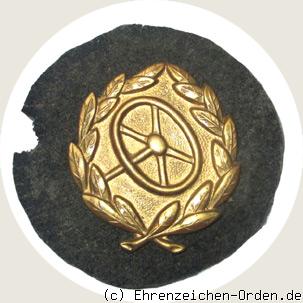 Face: Driving safety sign in gold
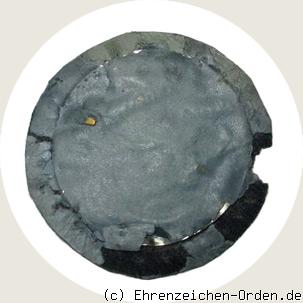 Downside: Driving safety sign in gold
Established:
October 23, 1942 Adolf Hitler
Data:
- Material: gold-plated iron sheet, fabric lining
- Size: 40mm x 44mm
- Weight: about 6.3g
estimated collector price:
70 – 80 €

 Awards of World War II