Germany Awards - General Storm Sign without Operation Number
After the infantry assault marks were established, the main command of the ground forces recognized that it was necessary to establish a common assault mark for soldiers who were not eligible for the award of infantry assault marks. On June 1, 1940, by order of the Commander-in-Chief of the Ground Forces Brauchitsch, this was introduced. The requirements for acquisition were the same as for infantry assault marks without belonging to one or another part of the troops. During the war, the assault badge was expanded and awarded in the upper classes. By order of June 22, 1943, the Deputy High Command of the Ground Forces, Colonel Rudolf Schmundt, introduced the following increases, which were differentiated at the appropriate rates. As of July 1, 1943, there were 5 stages: no number, 25 sorties, 50, 75 and 100 sorties. In accordance with the Establishment Decree, the General Assault Badge was also awarded to foreign allies and members of the armed forces. It was also provided in the form of full casting or hollow embossing. Source: J. Nimmergut, Deutsche Orden und Ehrenzeichen before 1945, vol. IV, 2001.
High oval, openwork badge made of silver-plated zinc. At the back is a vertical pin. In the center of the eagle is the manufacturer's designation.
Front side:
- The margin is formed by an oval ring on which lie 10 oak leaves and acorns.
In the - lower part, a side rifle and a barrel hand grenade are crossed. They are superimposed on the edge.
- Above it inside the ring is the emblem of the army (an eagle with lowered wings in the paws of a swastika.
Downside:
- Smooth, silver-plated with a vertical pin.
- The manufacturer stamped - L/53 - for Hymmen & Co. Lüdenscheid.
Photos of www.militaria-berlin.de
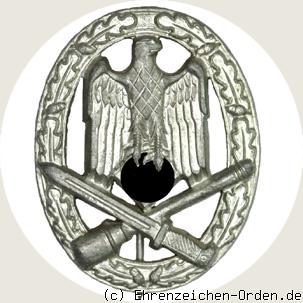 Front: Common storm sign without operation number
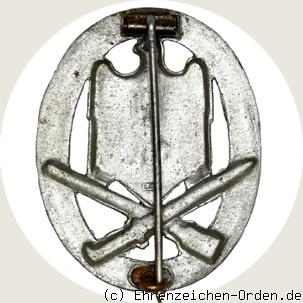 Downside: Common storm sign without operation number
Established:
June 1, 1940 Walter von Brauchitsch
Data:
- Material: silver-plated zinc
- Size: 42mm x 54mm
- Weight: 28.3g
estimated collector price:
90 - 110 € in zinc
170 - 190 € in silver-plated non-ferrous metal

 Awards of World War II