Germany Awards - 1914 Iron Cross 1st Class at Gode Needle
Iron Cross 1. The J. Godet & Sohn class is a typical award-winning piece with a needle and a flat finish. The manufacturer used only one type of core for the 1st class. Characteristic features are a very elevated crown and the letter W. Gaudet used a wider needle-like side on his back and an onion needle that comes out pointed down. Until the end of 1916, GOK (General Ordens Commission) entrusted the production of the 1st class only to Berlin firms, including 5 firms: Godet & Sohn, J. H. Werner, Gebrüder Friedlander, Sy & Wagner and Wagner & Sohn. Since 1917, other companies began to be involved. These include, first of all, Klein & Quenzer, whose crosses, in all likelihood, were marked KO. Emperor and King William II. Established the Iron Cross for World War I on August 5, 1914. The renewal of the Iron Cross in World War I consists of the 3rd class of the Grand Cross, 1st class and 2nd class. Godet crosses are popular with collectors because of the quality of the iron core. Source: Frank Wernitz, Iron Cross 1813-1870-1914, Volume 1 + 2, 2013.
The cross consists of a silver border and a silver back, which is soldered. The front part of the coffin has a raised, located inside, 2-step edge, from which the inner edge is shaded with a semicircular and small transverse stroke. Between them is an inner cross of blackened iron (magnetic). The reverse is smooth and silvery. Perpendicular straight needle with a response hook. On the needle in the middle is a G for Gode.
Front side:
In the - center of the iron core is the letter - W -.
- On the upper cross sleeve is the Prussian royal crown.
- On the lower cross sleeve number of the year - 1914 -.
Downside:
- Smooth silver with wide needle, onion needle and reciprocal hook.
- Center on the outside of the needle - G - for Godet & Sohn.
.
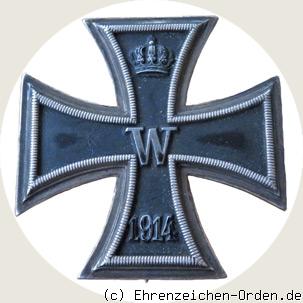 Front: Iron Cross 1st Class 1914 at Gaudet's Needle
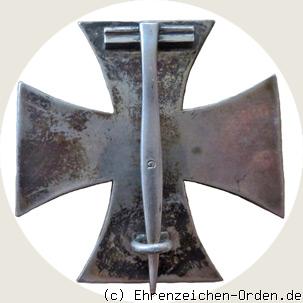 Reverse: Iron Cross 1st Class 1914 at Gaudet's Needle
Established:
August 5, 1914 by the emperor and king William II.
Data:
- Material: silver/iron
- Size: 42.3mm
- Weight: 17.4g
estimated collector price:
190 – 220 €

 Awards of World War II