Germany Awards - Iron Cross 1st Class 1914 with KMST Needle Fuse
Iron Cross 1. A class is a privately purchased second or spare item. The name of the manufacturer of the back panel KMST is unknown. Some collectors see this as an acronym for the Royal Stuttgart Mint. A feature of this cross is the attachment of the needle behind the counterhook, which prevents unintentional disengagement of the needle. The variant is among the rarer and is often sought after by collectors.
Emperor and King William II. Established the Iron Cross for World War I on August 5, 1914. The renewal of the Iron Cross in World War I consists of the 3rd class of the Grand Cross, 1st class and 2nd class. In 1918, Field Marshal Paul von Beneckendorf and Hindenburg as special uniforms were awarded the Star of the Iron Cross with Gold Rays. The reason was the successful spring offensive against France. The Iron Cross was "reburied" until 1924. This concerned, in particular, prisoners of war, unfulfilled petitions from the war and subsequent petitions. The deadline for applications was set for 31.05.1924.
Purchased items were offered by many manufacturers until the 1930s.
The cross consists of a silver border and a silver back, which is soldered to it. The front part of the coffin has a raised, located inside, 2-step edge, from which the inner edge is shaded with a semicircular and small transverse stroke. Between them is an inner cross of blackened iron (magnetic). The reverse is smooth silver with a vertical lapel pin with a mating hook and a pin fuse. The manufacturer is raised on the left cruciform shoulder. On the right is the abbreviation DRGM.
Front side:
In the - center of the iron core, the letter - W -
In the - upper cross sleeve Prussian royal crown
In - the lower cross sleeve year - 1914 -
Downside:
- Smooth with round needle and reciprocal hook. On the needle is a silver stamp - 800 -..
- On the left cruciform shoulder, the manufacturer's marking increases - K - M - S - T -.
- On the right cruciform shoulder rises - D - R - G - M - (Deutsches Reichsgebuschmuster).
- Needle end is spherical. Behind the counter hook is a small hinge with a hinged plate for attaching the needle.
Photos of www.militaria-berlin.de
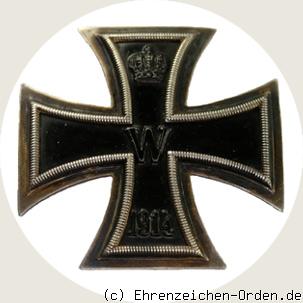 Face: Iron Cross 1st Class 1914 with KMST needle safety
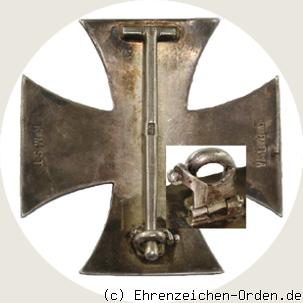 Reverse: Iron Cross 1.Class 1914 with KMST needle guard
Established:
August 5, 1914 by the emperor and king William II.
Data:
- Material: silver, iron
- Size: 43.5mm x 45.5mm
- Weight: 13.4g
estimated collector price:
higher than standard

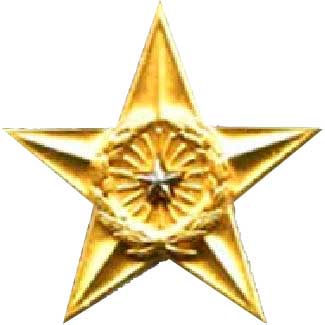 Awards of World War II