German Awards - Sports Wreath in Silver - National Automobile and Aviation Traffic Ring
Sports wreath - the highest award awarded by the "Ring of the National Automobile and Aviation Movement" (RKL). He was awarded gold and silver for distinguished service. RKL established other honorary badges and insignia. These include the sport eagle in gold and silver. This corresponds to a tilted eagle on a sports wreath. Badge of honor in gold, silver and bronze. It's an eagle inside a diamond. Service eagle of bronze or black color and penis badge, reduced eagle on the needle.
The National Automobile and Aviation Traffic Ring was an association within the NDA, the National German Automobile Club. It was founded in 1929 by the Steel Helmets Union (Stahlhelmbund) or the Imperial Kraftfahr Squadron (Reichs-Kraftfahr-Staffel). The leader and chairman was Karl Edward Duke of Saxony Coburg and Gotha. The goal was to unite all national (socialist) drivers on land, water and air. All car owners shared the RKL's conviction to link and counteract the "dominance" of German engine building. (National Motorist Front) constituent associations were: All-German Union, Oberland Union, German Association of Driver-Officers and Colonial Union. The NSKK (Nationalsozialistische Kraftfahrt-Korps) was a cooperating member until 1932 and could use the capabilities of the NDA. An honorary member was Prince Heinrich of Prussia.
The Steel Helmet Union began building motorized units in the early 20s and outperformed SA in members and vehicles. In 1930 it was 4,000 cars, with 2,800 passenger cars. Already in 1932 there were 25,000 cars and 715 motor towers. In October 1928, Stahlhelmbund founded the "Imperial Squadron Kraftfahra," which became the cradle of the national automobile and aviation movement.
In November 1932, there was a break, as the NSCC and Motor-SA refused to support the conference to strengthen the German automobile industry, which they had previously promised. Adolf Künlein, later the head of the NSKK, opposed the classification of the NSKK as equal among equal motorists at the front. Membership in the cooperative was terminated. The NSCC and SA and SS attack aircraft saw themselves as motorized and combat-ready media under the motto: domination of the state through domination of the road.
With the coming to power of the National Socialists during unification, the NSCC also included the NDA and the RKL.
Prominent bearers of the RKL sports wreath were, in particular, Hermann Goering and Adolf Künlein, as well as Karl Eduard von Saxe-Coburg and Gotha, but they were definitely in gold.
Openwork high oval badge made of silver-plated non-ferrous metal. On the back is a vertical pin with a hook.
Front side:
- The rim is formed by a wreath connected from below by a loop.
- On the left is laurel and on the right is oak foliage. Above, a wreath flows into the imperial crown.
- An eagle of the RKL with strongly elongated straight wings is obliquely placed on the wreath.
- The wings rise above the wreath to the left below and to the right above the center.
- On the wings in the center is a smaller plastically depicted eagle with a crown looking to the left.
- On the eagle with a fracture, the letters - R - K - L - increase. Ta - K - on the chest of the eagle.
- That - R - on the left, and that - L - on the right on the newly spread wings.
Downside:
- Hollow embossed, negative face. The back of the eagle is smooth.
- Perpendicular to the round pin. Loop at the bottom of the imperial crown.
- Counterhook on the loop.
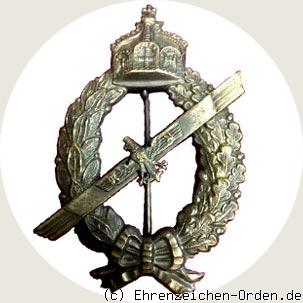 Front: a sports wreath in silver - the ring of the national automobile and aviation movement
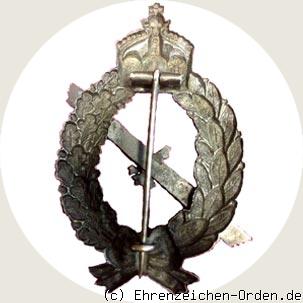 Reverse: a sports wreath in silver - the ring of the national automobile and aviation movement
Established:
circa 1929 on the ring of the national automobile and aviation traffic
Data:
- Material: non-ferrous silver-plated metal
- Size: approx. 69mm x 46mm, eagle approx. 63mm
- Weight:
estimated collector price:
700 – 900 €

 Awards of World War II