Germany Awards - Cross for years of voluntary Samaritan service
The badge of honor depicted here was most likely donated by the Samaritan land union of Saxony. In addition to the cross, there was also a medal for voluntary Samaritan service. All the documents I know belong to the Saxon Union with headquarters in Leipzig and date back to about the 30s. Thus, the fund can fall into the years after the First World War. The medal was awarded for 10 years of service. The cross depicted here was to be awarded for at least 15 or 20 years of service.
Samaritan German clubs met at the 1st Samaritan Meeting on August 22-25, 1895 in Kassel. It was there that the foundation was laid for the creation of the German Samaritan Union. Unions, organizations and sanitary trains in fire departments dedicated to Samaritans and rescuers in peacetime were to organize into land unions. An all-German Samaritan day was to be held each year. As a club and federal magazine, Samaritan was published. The honorary president was Friedrich von Esmarch (1823-1908), considered the founder of the Samaritan cause in Germany. He was a surgeon, privy medical adviser and major general of the medical corps of the Prussian army. These include, in particular, knitwear and first aid kit.
On September 18-20, 1896, the German Samaritan Union was founded in Berlin. 11 Samaritan days passed before World War II. In 1908, the Union was renamed the "German Society of Samaritans and Rescuers." During the World War, the Samaritans practically ceased to exist. The reason for this was also the conscription of members into the army. Paul Streffer, who became chairman in 1912, did not attempt to revive the society until 1926. In Saxony, which even before the war was considered the center of Samaritan clubs, the Landsamarite Association continued to hold land meetings. In 1927, there were 45 more Samaritan societies, with about 5,000 registered persons, 110 cooperative members and 1874 active members.
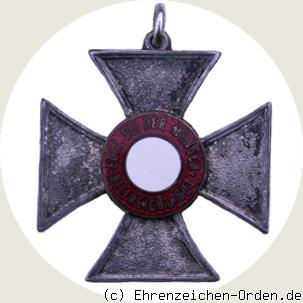
Non-ferrous metal cross in the form of the Iron Cross. Crosses with raised, stepped edges. The insides are finely indented. On the front side is a relief round enameled medallion. On the upper cruciform shoulder is a parallel eye with a ribbon ring.
Front side:
- Round medallion with a wide ring. It is painted silver and enameled with red translucent enamel. It has a silver inscription:
- Above - NOBLE - BE - THAT - MAN -, below separated by two dots - USEFUL - w.- GOOD -.
- The included midfield is enamelled in white.
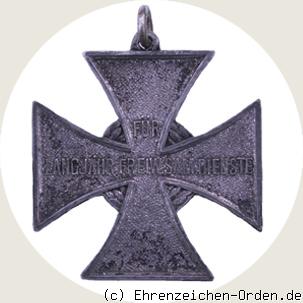
Downside:
- There is a sublime font on the finely divided cross sleeves.
- On the upper cross-piece to the center - FOR -, across the horizontal cross-pieces:
- - LONG-TERM - FREE - SAMI - SERVICES -.
Tape:
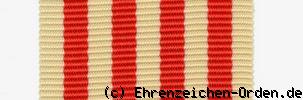
27 mm wide, alternating between 5 white and 4 red stripes of 3 mm.
Paintings from the collection of Mikhail Belenky.
.
 Obverse: Cross for years of voluntary Samaritan service
 Reverse: Cross for years of voluntary Samaritan service
Established:
1920 - Land Samaritan Union of Saxony
Data:
- Material: silver-plated copper alloy, partially enameled
- Size: 36mm
- Weight: 12.59g
estimated collector price:
70 – 90 €

 Awards of World War II