German Awards - German Cycling Badge in Gold
The German cycling sign presented here in gold is the highest step of the sign donated in 1925. No achievements are set for the gold badge. Exceptional successes in international and national cycling, as well as outstanding achievements in cycling, were probably necessary to confer this degree. The gold level is extremely rare. (today only 1 piece is occupied).
The Union of German Cycling Associations was founded on 13 April 1924 in Kassel. In 1925, the association consisted of 11 affiliated associations. V.D.R.V. (so abbreviation) had the subtitle Schutzgemeinschaft deutscher Raid- und Kraftradfahrter. So, the association also represented the interests of motorcyclists. In general, she represented the interests of independent amateur cycling federations. On August 16, 1925, Leipzig hosted VDRV German Cyclist Day. The association established uniform competition rules for individual disciplines and their ranking. It can be assumed that within this framework the German cycling sign presented here was established. He was awarded bronze, silver and gold in 3 stages. The purpose of the award was public recognition of versatile achievements in the field of cycling. There must be an incentive to achieve the equivalent physical fitness necessary for full strength, and to preserve this body ability until old age. In order to apply for a sign, it was necessary to have a one-year membership in the cycling federation. To purchase, it was necessary to pass 3 different exams within one year. They were selected from 6 disciplines and sports. Among them 1. Fast Riding, 2nd Control Riding, 3rd Pedestrian Riding, 4th Riding, 5th Shore Riding, and 6th Bicycle Ball. The values to be achieved were prescribed for bronze and silver.
Notable manufacturers were Lehmann & Wundenberg of Hanover and E. Wiedmann of Frankfurt am Main. The award continued under National Socialism and ended, probably with the outbreak of World War II.
High oval, embossed, above and below openwork sign made of gilded silver. Rear side with perpendicular pin with wide flat response hook. The manufacturer goes deep next to the hook.
Front side:
- The edge is formed from a 5-fold ligated wreath, 2 times on the sides and 1 time below.
- On the right, the wreath consists of bay leaves, and on the left of oak leaves.
In the - middle part there is a spoke wheel superimposed by an eagle with a chest shield.
- On the ribbons around the wreath there is a deepened font: at the top left - THROUGH -, at the top right - SPORT -,
- lower left - ZU -, lower right - KRAFT -. At the very bottom is a 2-line abbreviation - HP -/- RV -.
- On the curved shield of the eagle facing left up, a deepened 5-line font:
- - FOR -/- EXCELLENT -/- PERFORMANCE -/- IM -/- CYCLING -.
Downside:
- Smooth and gilded with a vertical pin with a flat reciprocal hook.
- To the left of the hook is the manufacturer - LEHMANN - u.-/- WUNDENBERG -/- HANNOVER -.
- Including a silver stamp - 800 -.
.
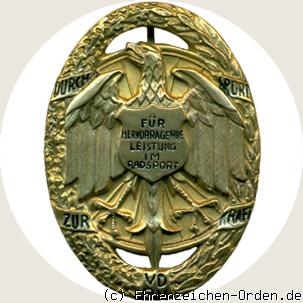 Front: German cycling badge in gold
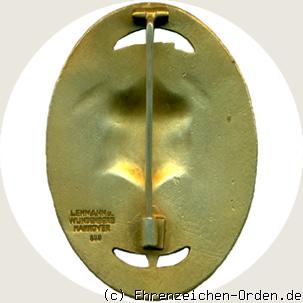 Reverse: German cycling badge in gold
Established:
1925 Association of German Cycling Associations
Data:
- Material: Silver gilded
- Size: 49.85mm x 36.4mm
- Weight: 22.46g
estimated collector price:
Unspecified

 Awards of World War II