German Awards - Bundesdank Badge of the Saxon Union of Military Associations
The Bundesdank sign was established on the occasion of the 50th anniversary of the Bundes on July 29, 1923. This was the highest award of the Federation until 10 years later, on the occasion of the 60th anniversary, the Bundesdank badge with a crown was established.
The most famous carriers were probably Emperor Wilhelm II, Prince Johann George V of Saxony and Prince Frederick Christian V of Saxony. The Saxon Military Union was founded in 1873. Since 1892 it was called the Royal Saxon Military Union. At the time, KSMVB consisted of approximately 1,200 clubs with approximately 137,000 members. In 1889, uniform insignia were introduced in S.M.V.B. These included membership badges, functional badges for boards, and then special honorary badges for multi-year membership. After World War I, 1920 were 1 a badge of honor and 2. Class created. In 1923, they were supplemented with the 3rd class badge of honor. Other awards of the Association established in the 20s were honorary chapter insignia, federal insignia. The badge of honor for women and the Bundesdank badge with a crown followed in 1930 and 1933, respectively. In 1933, the Association, like many others, was forcibly incorporated into the Union of Nazi Kaifhausers. At the time of amalgamation, S.M.V.B. had about 1,700 clubs with about 196,000 members.
The design of the badge belongs to Prof. Dr. Gebhardt. The signs were made by Glaser and Son in Dresden.
Gilded embossed non-ferrous badge. The inside is enameled green-white. The reverse is smooth and gilded with a perpendicular pin. Under pressure from manufacturers.
Front side:
- The edge is formed from a golden wreath tied from below with a double loop.
- On the left is laurel and on the right is oak foliage. Above, an image of a federal sign.
- At the ends of the loop increased, on the left the number - 1873 - on the right the number - 1923 -.
- The enclosed field is enameled obliquely green-white. (green below), separated by a golden line
. - It has a 3-line gold font: smaller - DES -/- COVENANT -/- THANK YOU -.
Downside:
- Smooth and gilded with a vertical pin.
- Above the needle of manufacturers - GLASER&SOHN -/- DRESDEN -/- GES. GESCH. –
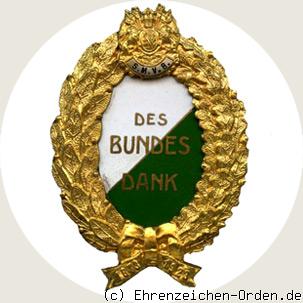 Obverse: Bundesdank sign of the Saxon Union of Military Associations
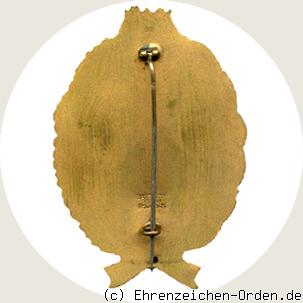 Reverse: Bundesdank sign of the Saxon Union of Military Associations
Established:
July 29, 1923 Saxon Military Union
Data:
- Material: non-ferrous metal with gilding, enamel
- Size: 69.7mm x 48.7mm
- Weight: 39.5g
estimated collector price:
250 – 275 €

 Awards of World War II